The paper is available online as a preprint at https://arxiv.org/abs/2503.07614.
"Today all mathematiciansand physicists agree that the field of applications for
mathematics knows no limits except those of knowledge itself."
Sergei Bernstein
It's hard
to imagine human life in the digital and AI age without polynomials, as they
are everywhere around us but often invisible to most people: in data trends, on
computer screens, in the shapes around us, and the very fabric of technology.
Polynomials drive computer animation in movies, optimise routes in navigation
systems such as GPS, model complex physical phenomena from planetary motion to
the spread of infectious diseases, and are part of models of many complex
systems that help us better understand the world around us. They're at the heart
of the algorithms that process images, the central part of the geometric
kernels in CAD systems. They're used to predict weather conditions and compress
the music we listen to daily. In engineering, they define structural designs
and stress analysis; in economics, they model growth and fluctuations; in
machine learning, they help build predictive models. Polynomials are not just
equations made up of mathematical symbols - they are the silent architects of
the modern digital world, shaping how we interact with technology, interpret
data, and design innovation contours.
One
of these polynomials is the simple but elegant Bernstein polynomial, which has
been a pivotal concept in mathematics since it was introduced by Sergei
Bernstein in 1912, and later found its applications in the fields of computer-aided
geometric design (CAGD) and computer-aided design (CAD) [1]. These polynomials
have the following form

where
 is
a Bernstein coefficient, and
is
a Bernstein coefficient, and
 Bernstein
basis polynomials of degree
Bernstein
basis polynomials of degree
 are
defined by
are
defined by

where
 is
a binomial coefficient.
is
a binomial coefficient.
Initially
used in a constructive proof for the Weierstrass approximation theorem, these
simple but elegant polynomials have evolved into a fundamental tool for
approximation theory, numerical analysis, and computer-aided geometric design
(CAGD) [1]. Their simple yet profound nature has allowed them to remain an
active research topic in CAGD for more than one hundred years, stimulating
further exploration and various applications in engineering.
The
enduring significance of Bernstein polynomials stems from their simplicity,
elegance, and versatility. Their key properties, such as non-negativity,
partition of unity, and shape-preserving characteristics, make them
indispensable for mathematical modelling, curve fitting, and optimisation
problems [2]. Their association with Bézier
curves and surfaces in the form of basis functions has also made them a
cornerstone in computer graphics, computer-aided design (CAD), and VR, enabling
the creation of visually appealing and mathematically precise geometric shapes
vital for digital manufacturing and 3D printing.
Out of a
total of 16,392 Scopus-indexed documents containing the keywords "Bézier
surface" or "Bézier
surface", "Bernstein-Bézier
curve" or "Bernstein-Bézier
surface" are only mentioned in 416 documents in all search fields, i.e.
only 2.57%. From one point of view, this is a pity, but from another point of
view, these days, who mentions the software or programming language used for their
discoveries in the title of a manuscript or the name of a new theorem or
method? The various tools we use in research have often become the silent
architects of scientific progress.
The
applications of Bernstein polynomials and their generalisations have expanded
across diverse disciplines, including recognition of human speech [3],
probability [4], and the theory of desirable gambles [5]. This growth has been
accompanied by extensive research, continuously enhancing our understanding of
these polynomials and their properties and reflecting their ongoing relevance.
Over the past century, the research on Bernstein polynomials has experienced
significant growth and development [6].
This
manuscript presents a pioneering bibliometric data analysis of Bernstein
polynomials based on RIS data file download from the Scopus database
(http://scopus.com/), analysing publications since 1949. The aim is to examine
the evolution of research topics, identify key contributors and organisations,
funding agencies, and influential works, and search for areas where Bernstein
polynomials are rarely mentioned. This analysis aims to provide a valuable
resource that encapsulates Bernstein polynomials' historical progress and
future potential. The Scopus search query TITLE-ABS-KEY(polynomial AND
"bibliometric analysis") returns 23 papers, but
"polynomial" is not in the title of these papers, which means that
our work may be the first-ever attempt at bibliometric analysis of polynomials,
at least based on papers indexed in the Scopus database.2 of polynomials, at least based on papers indexed in the Scopus database.
A search was conducted for
documents (excluding preprints, patents, and secondary documents) with the
keyword "Bernstein polynomial" in all fields. Scopus, one of the
largest web bibliometric databases, was used to obtain the dataset. Several
keywords were used to find weak connections to Bernstein polynomials and to
attract academics for research on Bernstein polynomials applied to found areas.
Our study excludes documents that may use Bernstein polynomials under other names,
as they were called before the term "Bernstein polynomials" became
widely accepted in the academic community.
To carry out a bibliometric
analysis, we followed the generally accepted steps: (1) study or research design,
(2) data collection, (3) data analysis, (4) data visualisation, and (5)
interpretation of results. We used VOSviewer v. 1.6.20 software and various AI
chatbots such as ChatGPT, Llama, Mixtral, and Perplexity to analyse and
visualise our data. The simple statistics, including the most productive
authors, organisations, and others, were extracted from the Scopus database,
and the relative percentages were calculated in Microsoft Excel. To carry out
the co-citation analysis, we used the VOSviewer3
software, which is used in bibliometric analysis to map networks
and evaluate the strength of links.
We used the standard 32-bit colour
maps available in VOSviewer to visualise the networks. The colour maps used
facilitate the presentation of large amounts of bibliometric data and allow
clear visualisation of network structures. However, users can easily customise
and extend this colour mapping functionality by designing their colour maps for
more accurate colour representation. This flexibility allows the creation of
more nuanced and detailed visualisations, particularly for huge network
datasets.
When exporting visualisations in
VOSviewer, the software adds its logo in the lower left corner, but it's
missing on screenshots. Again, we want to emphasise that all visualisations
have been made with the software mentioned. As no copyright information exists
on their website, adding the logo could be seen as an advertising method.
Basic
statistics, such as subject area, source title, etc., can be copied or scraped
directly from the Scopus search results page. As of 23 January 2025, the
keyword "Bernstein polynomial" is mentioned in 2371 documents'
titles, abstracts or keywords, and the search within all fields returns 9310 documents
starting from 1949. Such a significant difference may indicate that many papers
cite "Bernstein polynomials" without directly researching them but
using them in various fields. As we are looking for multiple applications of
these polynomials, we would consider the dataset with 9310 documents, including
77 articles in press, for our research. Of these, 84.9% are articles, 11%
conference papers, 1.8% book chapters, 1.1% reviews, 0.8% books, 0.2% notes,
0.1% editorials and 0.3% other sources. Interestingly, only two retracted
papers among the documents show a high academic culture level in this field.
Most of
the Scopus subject areas that mention the Bernstein polynomial are shown in
Figure 1, where the most popular subject areas are Mathematics, Computer
Science, Engineering, and Physics & Astronomy. Fields such as Materials
Science, Chemistry, Earth and Planetary Sciences, Energy, Biochemistry,
Genetics and Molecular Biology, Agricultural and Biological Sciences,
Multidisciplinary, Environmental Science, Economics, Econometrics and Finance,
Social Sciences, Chemical Engineering, Medicine, Business, Management and
Accounting, Neuroscience, Immunology and Microbiology, Arts and Humanities,
Health Professions, Pharmacology, Toxicology and Pharmaceutics, Psychology,
Nursing, Dentistry have less than 2% of all documents for each field.

Figure 1.
A pie
chart from Scopus shows the percentage of total mentions of the keyword
"Bernstein polynomial" in different subject areas.
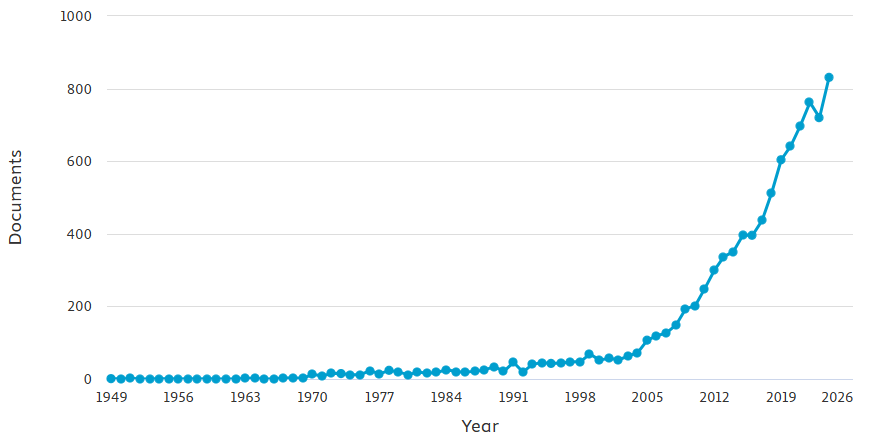
Figure 2 shows the dynamics of annual publications and
the twenty most popular keywords since 1949. From around 2005, we can observe a
significant growth in the number of documents and, consequently, in the number
of keywords.
(a)

(b)
Figure 2.
(a) Number
of documents since 1949. The year 2025 is not shown here, and 70 publications
have been indexed in Scopus. (b) The evolution of the twenty most popular
keywords in manuscripts. The evolution of keywords with ten or more occurrences,
as produced by the ScienceScape4
online tool, can be found online at https://youtu.be/DQBZHmngCN0
The 100
most popular sources, mainly containing prestigious journals, account for 4060
or 43.6% of the 9310 documents in the database (see Table 1). Most of these are
mathematics, computer, and applied sciences-related periodicals.
Table 1.
The list of the most popular source titles where the keyword
"Bernstein polynomial" appears in all search fields.
|
Source name
|
Number of documents
|
|
Journal of Approximation Theory
|
240
|
|
Applied Mathematics and Computation
|
205
|
|
Journal of Computational and Applied Mathematics
|
165
|
|
Mathematical Methods in the Applied Sciences
|
138
|
|
Journal of Inequalities and Applications
|
112
|
|
Journal of Mathematical Analysis and Applications
|
105
|
|
Filomat
|
101
|
|
Computer Aided Geometric Design
|
97
|
|
Mathematics (MDPI)
|
95
|
|
Journal of Computational Analysis and Applications
|
94
|
|
Advances in Difference Equations
|
91
|
|
Results in Mathematics
|
89
|
|
Lecture Notes in Computer Science, including Subseries
Lecture Notes in Artificial Intelligence and Lecture Notes in Bioinformatics
|
78
|
|
AIP Conference Proceedings
|
76
|
|
Symmetry
|
66
|
|
Abstract and Applied Analysis
|
61
|
|
Computational and Applied Mathematics
|
61
|
|
International Journal of Applied and Computational
Mathematics
|
55
|
|
Computers and Mathematics with Applications
|
54
|
|
Numerical Algorithms
|
54
|
|
Advanced Studies in Contemporary Mathematics
Kyungshang
|
51
|
|
Numerical Functional Analysis and Optimization
|
46
|
|
Mediterranean Journal of Mathematics
|
44
|
|
Applied Numerical Mathematics
|
42
|
|
Chaos Solitons and Fractals
|
40
|
|
Computational Statistics and Data Analysis
|
40
|
|
Proceedings of The Jangjeon Mathematical Society
|
40
|
|
Mathematics and Computers in Simulation
|
39
|
|
Demonstratio Mathematica
|
36
|
|
Aims Mathematics
|
35
|
|
Applied Mathematical Sciences
|
35
|
|
Acta Mathematica Hungarica
|
34
|
|
Constructive Approximation
|
33
|
|
Iranian Journal of Science and Technology Transaction
A Science
|
33
|
|
Carpathian Journal of Mathematics
|
32
|
|
Springer Proceedings in Mathematics and Statistics
|
32
|
|
Fractal and Fractional
|
31
|
|
Engineering with Computers
|
30
|
|
Advances in Computational Mathematics
|
28
|
|
Alexandria Engineering Journal
|
28
|
|
Applied Mathematical Modelling
|
28
|
|
IEEE Transactions on Antennas and Propagation
|
28
|
|
Applied Mathematics Letters
|
27
|
|
Communications in Statistics Theory and Methods
|
27
|
|
IEEE Access
|
27
|
|
International Journal of Mathematical Analysis
|
27
|
|
Journal of Nonparametric Statistics
|
27
|
|
Turkish Journal of Mathematics
|
27
|
|
Applied Mathematics and Information Sciences
|
26
|
|
Approximation Theory and Its Applications
|
26
|
|
Journal of Physics Conference Series
|
26
|
|
Mathematical Sciences
|
26
|
|
Revista De La Real Academia De Ciencias Exactas
Fisicas Y Naturales Serie A Matematicas
|
26
|
|
Journal of Function Spaces
|
25
|
|
Mathematical Foundations of Computing
|
25
|
|
International Journal of Computer Mathematics
|
24
|
|
Journal of Vibration and Control
|
24
|
|
Journal of Statistical Planning and Inference
|
24
|
|
Springer Optimization and Its Applications
|
24
|
|
Computational Methods for Differential Equations
|
23
|
|
Computer Methods in Applied Mechanics and Engineering
|
23
|
|
Journal of Mathematical Inequalities
|
23
|
|
Soft Computing
|
23
|
|
Calcolo
|
22
|
|
Fuzzy Sets and Systems
|
22
|
|
IEEE Transactions on Signal Processing
|
22
|
|
Journal of Multivariate Analysis
|
22
|
|
Positivity
|
22
|
|
International Journal of Pure and Applied Mathematics
|
21
|
|
Mathematical and Computer Modelling
|
21
|
|
Mathematical Problems in Engineering
|
21
|
|
Rocky Mountain Journal of Mathematics
|
21
|
|
Statistics and Probability Letters
|
21
|
|
Studia Scientiarum Mathematicarum Hungarica
|
21
|
|
Applied Mathematics
|
20
|
|
CMES Computer Modeling in Engineering and Sciences
|
20
|
|
Electronic Journal of Statistics
|
20
|
|
International Journal of Mathematics and Mathematical
Sciences
|
20
|
|
Numerical Methods for Partial Differential Equations
|
20
|
|
Hacettepe Journal of Mathematics and Statistics
|
19
|
|
IEEE Signal Processing Letters
|
19
|
|
Journal of Computational Physics
|
19
|
|
Journal of The American Statistical Association
|
19
|
|
Advanced Studies in Theoretical Physics
|
18
|
|
Communications in Statistics Simulation and
Computation
|
18
|
|
Georgian Mathematical Journal
|
18
|
|
Journal of Numerical Analysis and Approximation Theory
|
18
|
|
Mathematica Slovaca
|
18
|
|
Miskolc Mathematical Notes
|
18
|
|
Nonlinear Dynamics
|
18
|
|
Proceedings IEEE International Symposium on Circuits
and Systems
|
18
|
|
Proceedings of The American Mathematical Society
|
18
|
|
Studia Universitatis Babes Bolyai Mathematica
|
18
|
|
Annals of Statistics
|
17
|
|
Discrete Dynamics in Nature and Society
|
17
|
|
Journal of Applied Mathematics and Computing
|
17
|
|
Journal of Intelligent and Fuzzy Systems
|
17
|
|
Axioms
|
16
|
|
Energy
|
16
|
|
Fractals
|
16
|
|
|
|
|
Figure 3 shows the dynamics of the number of
mentions of the keyword "Bernstein polynomial" in the four most
popular journals from Table 1. The number of mentions of the keyword in Applied
Mathematics and Computation has significantly decreased since 2015, while the
number of mentions of the keyword "Bernstein polynomial" in the
journal Mathematical Methods in the Applied Sciences has increased. Such
changes could be related to the increased difficulty of publishing in the
mentioned journal, changes in editorial policy or the impact factor,
preferences of academics, etc.
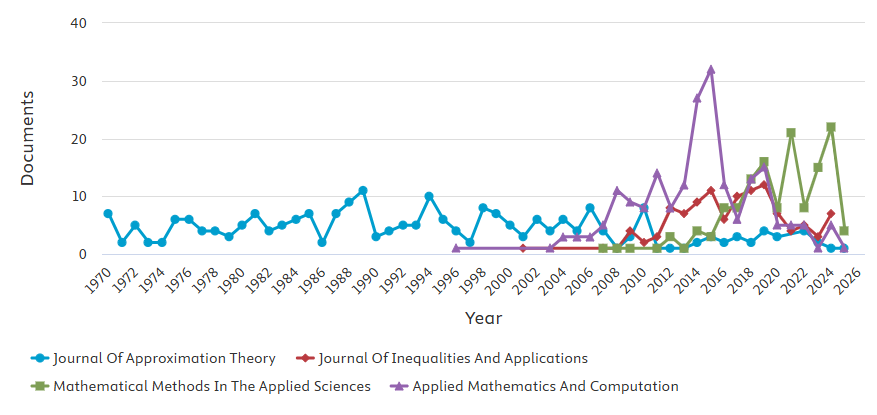
Figure 3.
The
dynamics of the number of mentions of the keyword "Bernstein
polynomial" in the four most popular journals from Table 1.
Table 2 shows the list of authors'
countries where documents with the keywords "Bernstein polynomial"
were found in one of the search fields. As can be seen, China, USA and India
dominate the list. Russia and Libya are mentioned twice in the Scopus database
under different names for which the corresponding number of papers has been
added. Some papers were not identified by geographical location, but their
total share is only 1.3%. Russia's 19th place is surprising, as Bernstein
polynomials were discovered there. However, this may be due to the authors'
preference to publish their related research in Russian sources that are not
indexed in academic databases. E-library (https://elibrary.ru/), a central
Russian academic database, mentions only 67 documents for "полином Бернштейна"
(singular form), 48 documents for "многочлен Бернштейна"
(singular form), 101 documents with "многочлены Бернштейна"
(plural form) and 182 documents with "полиномы Бернштейна"
(plural form) in all fields, including the full text of a document.
Table 2.
The list of authors, countries.
|
Country/Territory
|
Documents
|
Percentage
|
|
China
|
1530
|
16.43%
|
|
United States
|
1371
|
14.73%
|
|
India
|
1113
|
11.95%
|
|
Turkey
|
935
|
10.04%
|
|
Iran
|
899
|
9.66%
|
|
Romania
|
509
|
5.47%
|
|
South Korea
|
508
|
5.46%
|
|
Germany
|
494
|
5.31%
|
|
Saudi Arabia
|
389
|
4.18%
|
|
Italy
|
373
|
4.01%
|
|
France
|
299
|
3.21%
|
|
Canada
|
278
|
2.99%
|
|
United Kingdom
|
268
|
2.88%
|
|
Spain
|
259
|
2.78%
|
|
Egypt
|
195
|
2.09%
|
|
Taiwan
|
188
|
2.02%
|
|
Pakistan
|
165
|
1.77%
|
|
Japan
|
161
|
1.73%
|
|
Russia
|
151
|
1.62%
|
|
Poland
|
143
|
1.54%
|
|
Malaysia
|
135
|
1.45%
|
|
Iraq
|
127
|
1.36%
|
|
Australia
|
126
|
1.35%
|
|
Jordan
|
92
|
0.99%
|
|
South Africa
|
76
|
0.82%
|
|
Switzerland
|
74
|
0.79%
|
|
Netherlands
|
71
|
0.76%
|
|
Bulgaria
|
70
|
0.75%
|
|
Thailand
|
70
|
0.75%
|
|
Portugal
|
69
|
0.74%
|
|
Israel
|
67
|
0.72%
|
|
Hong Kong
|
65
|
0.70%
|
|
Singapore
|
65
|
0.70%
|
|
Belgium
|
64
|
0.69%
|
|
Mexico
|
64
|
0.69%
|
|
Algeria
|
60
|
0.64%
|
|
Hungary
|
54
|
0.58%
|
|
Brazil
|
50
|
0.54%
|
|
Viet Nam
|
50
|
0.54%
|
|
Austria
|
43
|
0.46%
|
|
Greece
|
43
|
0.46%
|
|
Norway
|
41
|
0.44%
|
|
United Arab Emirates
|
40
|
0.43%
|
|
Ukraine
|
38
|
0.41%
|
|
Morocco
|
35
|
0.38%
|
|
Nigeria
|
35
|
0.38%
|
|
Sweden
|
33
|
0.35%
|
|
Azerbaijan
|
31
|
0.33%
|
|
Tunisia
|
29
|
0.31%
|
|
New Zealand
|
26
|
0.28%
|
|
Serbia
|
25
|
0.27%
|
|
Chile
|
23
|
0.25%
|
|
Denmark
|
23
|
0.25%
|
|
Ireland
|
22
|
0.24%
|
|
Czech Republic
|
21
|
0.23%
|
|
Indonesia
|
20
|
0.21%
|
|
Oman
|
20
|
0.21%
|
|
Yemen
|
20
|
0.21%
|
|
Colombia
|
19
|
0.20%
|
|
Bangladesh
|
17
|
0.18%
|
|
Finland
|
16
|
0.17%
|
|
Slovenia
|
15
|
0.16%
|
|
Lebanon
|
13
|
0.14%
|
|
Argentina
|
11
|
0.12%
|
|
Estonia
|
11
|
0.12%
|
|
Kazakhstan
|
11
|
0.12%
|
|
Kuwait
|
11
|
0.12%
|
|
Palestine
|
10
|
0.11%
|
|
Qatar
|
10
|
0.11%
|
|
Libya
|
8
|
0.09%
|
|
Ethiopia
|
9
|
0.10%
|
|
Cyprus
|
7
|
0.08%
|
|
Macao
|
6
|
0.06%
|
|
Slovakia
|
6
|
0.06%
|
|
Croatia
|
5
|
0.05%
|
|
Georgia
|
5
|
0.05%
|
|
Cameroon
|
4
|
0.04%
|
|
Ecuador
|
4
|
0.04%
|
|
Lithuania
|
4
|
0.04%
|
|
Tanzania
|
4
|
0.04%
|
|
Trinidad and Tobago
|
4
|
0.04%
|
|
Uruguay
|
4
|
0.04%
|
|
Uzbekistan
|
4
|
0.04%
|
|
Venezuela
|
4
|
0.04%
|
|
Afghanistan
|
3
|
0.03%
|
|
Bahrain
|
3
|
0.03%
|
|
Dominican Republic
|
3
|
0.03%
|
|
Peru
|
3
|
0.03%
|
|
Philippines
|
3
|
0.03%
|
|
Belarus
|
2
|
0.02%
|
|
Cote d'Ivoire
|
2
|
0.02%
|
|
Ghana
|
2
|
0.02%
|
|
Kyrgyzstan
|
2
|
0.02%
|
|
Malawi
|
2
|
0.02%
|
|
North Korea
|
2
|
0.02%
|
|
Yugoslavia
|
2
|
0.02%
|
|
Albania
|
1
|
0.01%
|
|
Armenia
|
1
|
0.01%
|
|
Benin
|
1
|
0.01%
|
|
Chad
|
1
|
0.01%
|
|
Honduras
|
1
|
0.01%
|
|
Jamaica
|
1
|
0.01%
|
|
Kenya
|
1
|
0.01%
|
|
Luxembourg
|
1
|
0.01%
|
|
Madagascar
|
1
|
0.01%
|
|
Mauritius
|
1
|
0.01%
|
|
Moldova
|
1
|
0.01%
|
|
Nepal
|
1
|
0.01%
|
|
North Macedonia
|
1
|
0.01%
|
|
Sierra Leone
|
1
|
0.01%
|
|
Swaziland
|
1
|
0.01%
|
|
Syrian Arab Republic
|
1
|
0.01%
|
|
Undefined
|
122
|
1.31%
|
Two South
Korean universities from Seoul top the list of authors, affiliations, followed by a Romanian, an Indian, a Chinese, a Saudi Arabian and
a Turkish university (see Fig. 4).

Figure 4.
Top ten
universities with documents containing the keyword "Bernstein
polynomial" in all search fields.
Other
universities and institutions mentioned in more than 30 documents include
Ankara University (Turkey), Universitatea Babeș-Bolyai
(Romania), Zhejiang University (China), Islamic Azad University (Iran),
University of Oradea (Romania), Kyungpook National University (South Korea),
Eastern Mediterranean University (Cyprus), Hannam University (South Korea),
Akdeniz University (Turkey), French National Centre for Scientific Research
(France), Shiraz University of Technology (Iran), University of Zaragoza (Spain),
Çankaya University (Turkey),
Ministry of Education of the People's Republic of China, Islamic Azad
University, Karaj Branch (Iran), Shahid Beheshti University (Iran), Lucian
Blaga University of Sibiu (Romania), Institute for Space Sciences, Bucharest
(Romania), Pukyong National University (South Korea), Xiamen University
(China), Malayer University (Iran), Atilim University (Turkey), Gaziantep
University (Turkey), Bolu Abant İzzet Baysal University (Turkey).
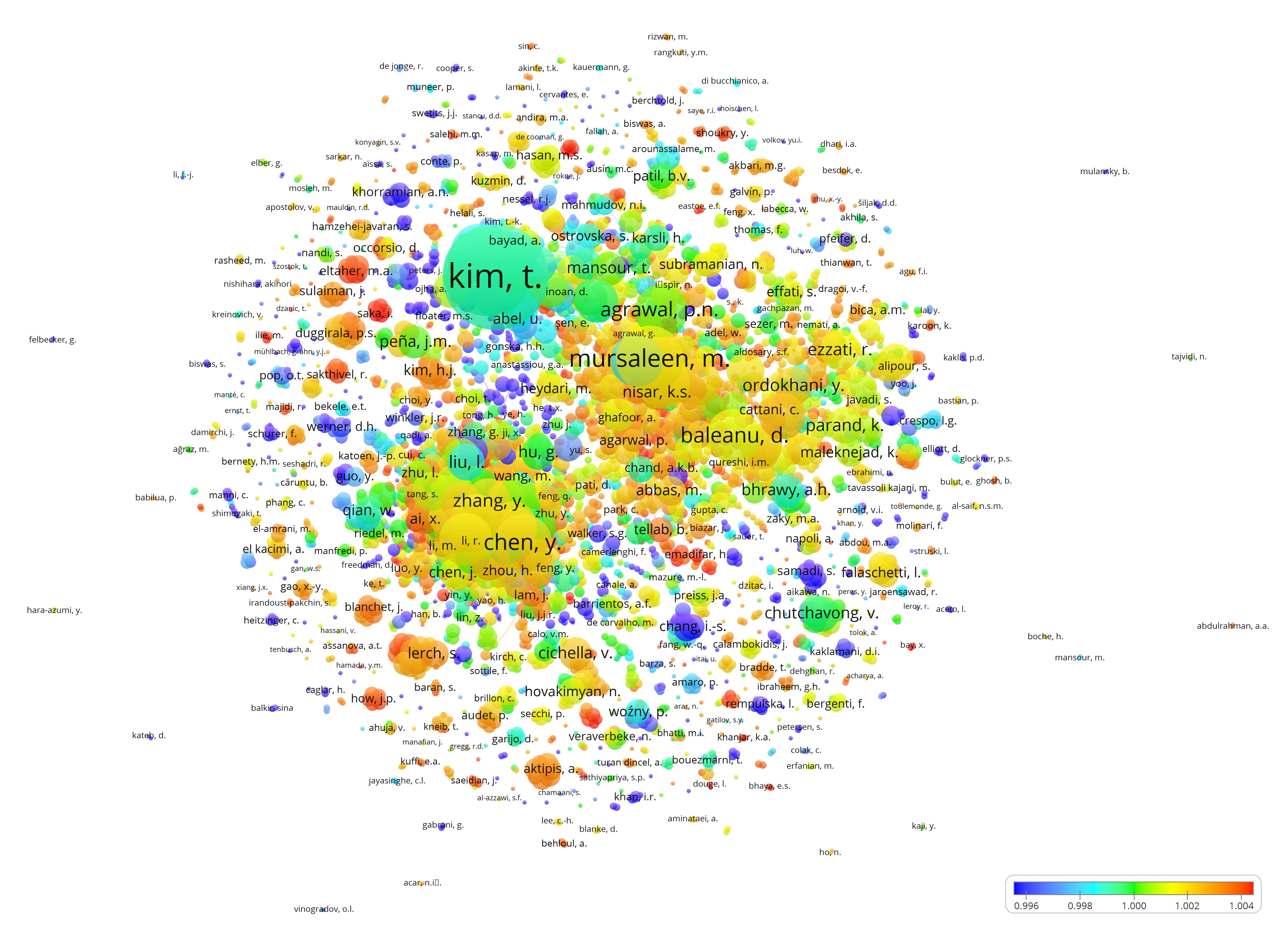
Figure 5
shows the top ten academics and the co-authorship network overlay visualisation
for 2010-2025 (the colours change from blue for older documents to red for
newer documents).

(a)

(b)

(c)

(d)
(e)
Figure 5.
(a) Top ten academics whose documents contain the keyword "Bernstein polynomial"
in all search fields, (b) Co-authorship overlay visualisation with a more
dynamic variant available online at https://youtu.be/ipblMZ_saKA (c)
Overlay visualisation in which the size of each node represents the
weight based on the number of documents, while the colour, which changes from
blue to red, reflects the normalised average publication year5, with blue representing older
documents and red representing more recent ones. (d) Overlay
visualisation in which the size of each node represents the weight based on the
number of links, while the colour, which changes from blue to red, reflects the
normalised average publication year, with blue representing older documents and
red representing more recent ones. (e) Overlay visualisation in which
the size of each node represents the weight based on the total link strength,
while the colour, which changes from blue to red, reflects the normalised
average publication year, with blue representing older documents and red
representing more recent ones.
The
list of funding agencies is shown in Table 2. The leading funding agency is the
National Natural Science Foundation of China, and the third one is the Ministry
of Science and Technology of the People's Republic of China, which indicates
the enormous support provided by China for research in areas related to
Bernstein polynomials and their applications. Although the National Research
Foundation of Korea is mentioned as a funding agency in only 68 documents,
authors from this country are among the most active researchers mentioning the
“Bernstein polynomial” in their documents (Fig. 5a).
Table 2.
The list of funding sponsors mentioned in documents with the
keywords "Bernstein polynomial" was found in any search field.
Unfortunately, some funding agencies do not include the name of a country in
their title, and some are written in a language other than English.
|
Funding sponsor
|
Documents
|
|
National Natural Science Foundation of China
|
657
|
|
National Science Foundation
|
293
|
|
Ministry of Science and Technology of the People's
Republic of China
|
209
|
|
European Commission
|
94
|
|
Natural Sciences and Engineering Research Council of
Canada
|
88
|
|
National Research Foundation of Korea
|
68
|
|
Deutsche Forschungsgemeinschaft6
|
67
|
|
National Institutes of Health
|
62
|
|
U.S. Department of Defense
|
62
|
|
Japan Society for the Promotion of Science
|
56
|
|
Fundamental Research Funds for the Central
Universities
|
54
|
|
University Grants Commission
|
53
|
|
Office of Naval Research
|
49
|
|
National Key Research and Development Program of China
|
47
|
|
Department of Science and Technology, Ministry of
Science and Technology, India
|
46
|
|
Ministry of Education of the People's Republic of
China
|
42
|
|
Natural Science Foundation of Fujian Province
|
41
|
|
Science and Engineering Research Board
|
38
|
|
European Regional Development Fund
|
37
|
|
Ministerio de Economía y Competitividad7
|
37
|
|
Air Force Office of Scientific Research
|
36
|
|
Council of Scientific and Industrial Research, India
|
35
|
|
U.S. Department of Energy
|
35
|
|
U.S. Department of Health and Human Services
|
35
|
|
Seventh Framework Programme
|
34
|
|
Engineering and Physical Sciences Research Council
|
33
|
|
Government of Canada
|
33
|
|
Natural Science Foundation of Zhejiang Province
|
33
|
|
Schweizerischer Nationalfonds zur Förderung
der Wissenschaftlichen Forschung8
|
33
|
|
European Research Council
|
32
|
|
China Postdoctoral Science Foundation
|
31
|
|
Horizon 2020 Framework Programme
|
31
|
|
Ministry of Education, Culture, Sports, Science and
Technology
|
31
|
|
Natural Science Foundation of Hebei Province
|
31
|
|
Ministry of Human Resource Development
|
30
|
|
Akdeniz University, Turkey
|
29
|
|
Directorate for Mathematical and Physical Sciences
|
29
|
|
U.S. Air Force
|
28
|
|
Air Force Materiel Command
|
27
|
|
Ministerio de Ciencia, Innovación y Universidades9
|
26
|
|
Ministero dell’Istruzione, dell’Università e della Ricerca10
|
26
|
|
U.S. Navy
|
26
|
|
Natural Science Foundation of Jiangsu Province
|
24
|
|
UK Research and Innovation
|
23
|
|
Istituto Nazionale di Alta Matematica "Francesco
Severi"11
|
22
|
|
Junta de Andalucía12
|
22
|
|
National Aeronautics and Space Administration
|
22
|
|
Agencia Estatal de InvestigaciÓn13
|
21
|
|
China Scholarship Council
|
21
|
|
Fundação para a Ciência e a Tecnologia14
|
21
|
The
second source of funding mentioned in 293 documents, the National Science
Foundation (NSF), doesn't mention any country by name, but an analysis of the
locations of the universities shows that 75.32% of all workplaces are in US
universities, and 5.06% are Chinese, 2.74% are Canadian, 2.11% are German and
British, 1.69% are French, and so on. Therefore, it's evident that the National
Science Foundation (https://nsf.gov) is an independent agency of the United
States federal government that supports fundamental research and education.
However, for efficient tracking of research funding, the name of the fund
mentioned in manuscripts should be unique, and various academic databases can
also integrate these names into the document properties so that it would be easy
to know that the development of a document was supported by research funding.
Analysis
of author names in NSF-supported documents using AI chatbots15
revealed that some US-based academics have names of Chinese and other origins (Table 3),
but different tools produced different results.
Table 3.
AI-based analysis of author names using different LLMs
performed on 23 January 2025. The values indicate the percentage of author
names that each model assigned to a given country, i.e. the proportional
distribution of inferred origins. The 'Average' column shows the mean
percentage across the three models.
|
Name origin
|
Llama 3
|
Perplexity
|
Mixtral
|
Average
|
|
United States
|
34.86%
|
35.00%
|
30.60%
|
33.49%
|
|
China
|
20.41%
|
20.00%
|
14.60%
|
18.34%
|
|
United Kingdom
|
5.36%
|
8.00%
|
2.40%
|
5.25%
|
|
Germany
|
3.59%
|
5.00%
|
6.10%
|
4.90%
|
|
Canada
|
3.59%
|
5.00%
|
7.90%
|
5.50%
|
|
France
|
3.59%
|
4.00%
|
4.30%
|
3.96%
|
|
India
|
3.59%
|
3.00%
|
5.50%
|
4.03%
|
|
Japan
|
1.79%
|
2.00%
|
0.60%
|
1.46%
|
|
Others
|
23.22%
|
18.00%
|
28.00%
|
23.07%
|
|
Total
|
100.00%
|
100.00%
|
100.00%
|
|
Table 4 shows the top 10 most cited papers, including citation counts, journal names,
and publishers. 40% of these top papers were published in Computer Aided
Geometric Design, a key Elsevier journal for research in the mathematical
foundations of free-form curves, surfaces and solids. A visualisation of the
evolution of sources that published ten or more documents related to the
keyword "Bernstein polynomial" in data extracted from Scopus can be
found online at https://youtu.be/CTZv1iTT7gA.
Table 4.
The top 10 most cited articles that contain the keyword
"Bernstein polynomial" in the article title, abstract or keywords
according to the Scopus database. The rationale behind searching the article
title, abstract or keywords rather than all fields was to identify papers that
focus on investigating Bernstein polynomials. The article by Sederberg &
Parry is indexed twice in Scopus, showing a different number of citations.
|
Authors
|
Year
|
Title
|
Source title
|
Cited by
|
Publisher
|
|
Sederberg Thomas W.; Parry Scott R. [7]
|
1986
|
Free-form deformation of solid geometric models
|
Computer Graphics (ACM)
|
2285
|
Association for Computing Machinery
|
|
Farin G. [8]
|
1986
|
Triangular Bernstein-B
é
zier
patches
|
Computer Aided Geometric Design
|
497
|
Elsevier
|
|
Farouki R.T. [9]
|
2012
|
The Bernstein polynomial basis: A centennial retrospective
|
Computer Aided Geometric Design
|
379
|
Elsevier
|
|
Farouki R.T.; Rajan V.T. [10]
|
1988
|
Algorithms for polynomials in Bernstein form
|
Computer Aided Geometric Design
|
257
|
Elsevier
|
|
Farouki R.T.; Rajan V.T. [11]
|
1987
|
On the numerical condition of polynomials in Bernstein
form
|
Computer Aided Geometric Design
|
241
|
Elsevier
|
|
King J.P. [12]
|
2003
|
Positive linear operators which preserve x2
|
Acta Mathematica Hungarica
|
236
|
Hungarian Academy of Sciences
|
|
Gao F.; Wu W.; Lin Y.; Shen S. [13]
|
2018
|
Online Safe Trajectory Generation for Quadrotors Using
Fast Marching Method and Bernstein Basis Polynomial
|
Proceedings - IEEE International Conference on
Robotics and Automation
|
212
|
Institute of Electrical and Electronics Engineers Inc.
|
|
Sederberg T.W.; Parry S.R. [14]
|
1986
|
Free-form deformation of solid geometric models
|
Proceedings of the 13th Annual Conference on Computer
Graphics and Interactive Techniques,
SIGGRAPH 1986
|
193
|
Association for Computing Machinery
|
|
Bhrawy A.H.; Taha T.M.; Machado J.A.T. [15]
|
2015
|
A review of operational matrices and spectral
techniques for fractional calculus
|
Nonlinear Dynamics
|
181
|
Kluwer Academic Publishers
|
|
Ostrovska S. [16]
|
2003
|
q
-Bernstein
polynomials and their iterates
|
Journal of Approximation Theory
|
180
|
Academic Press Inc.
|
Network visualisations and
analysis were performed using VOSviewer (https://www.vosviewer.com/), a freeware
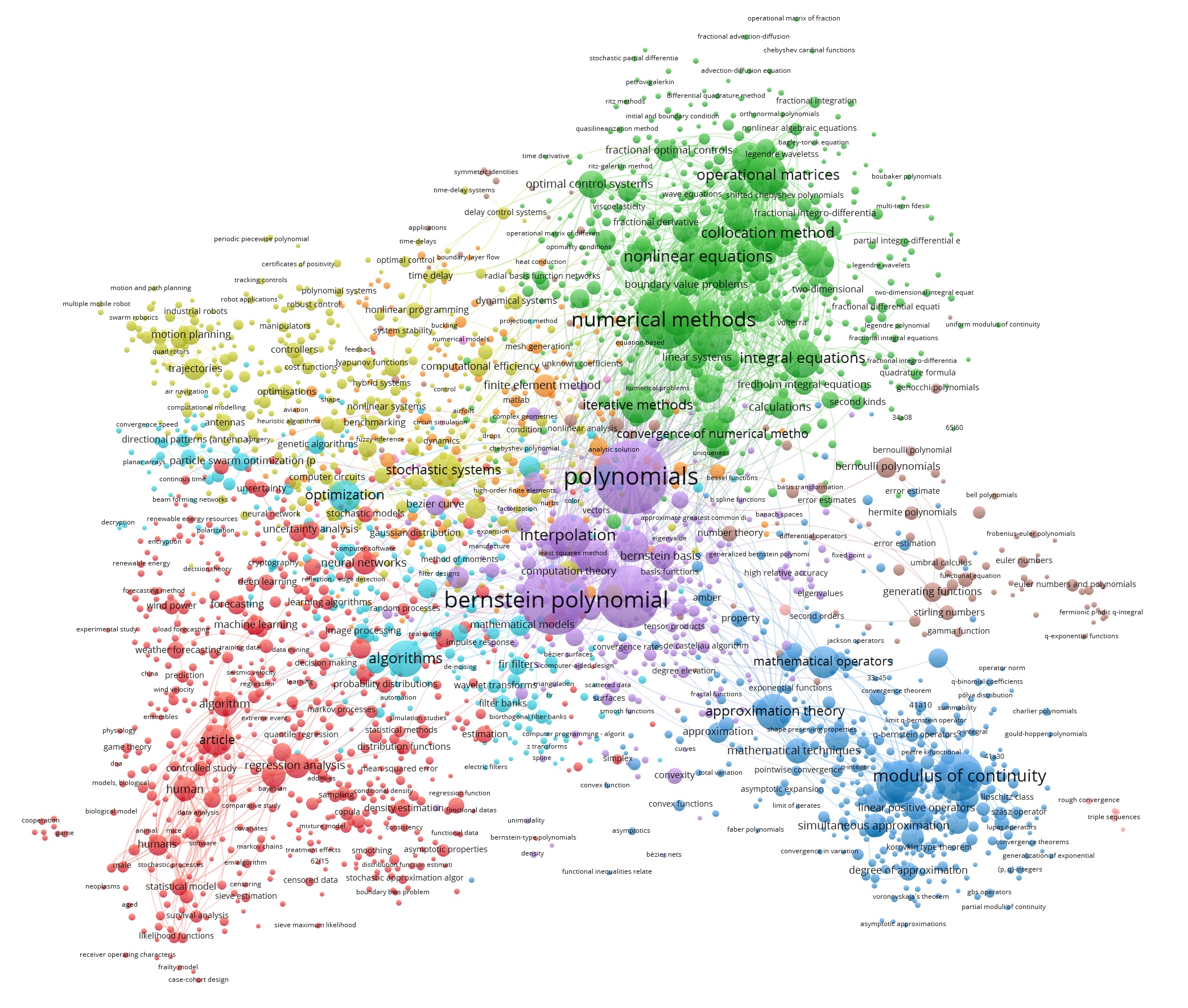
tool for constructing and visualising bibliometric networks. The minimum number
of occurrences of a keyword was set to 3, and 5087 keywords met the threshold. VOSviewer
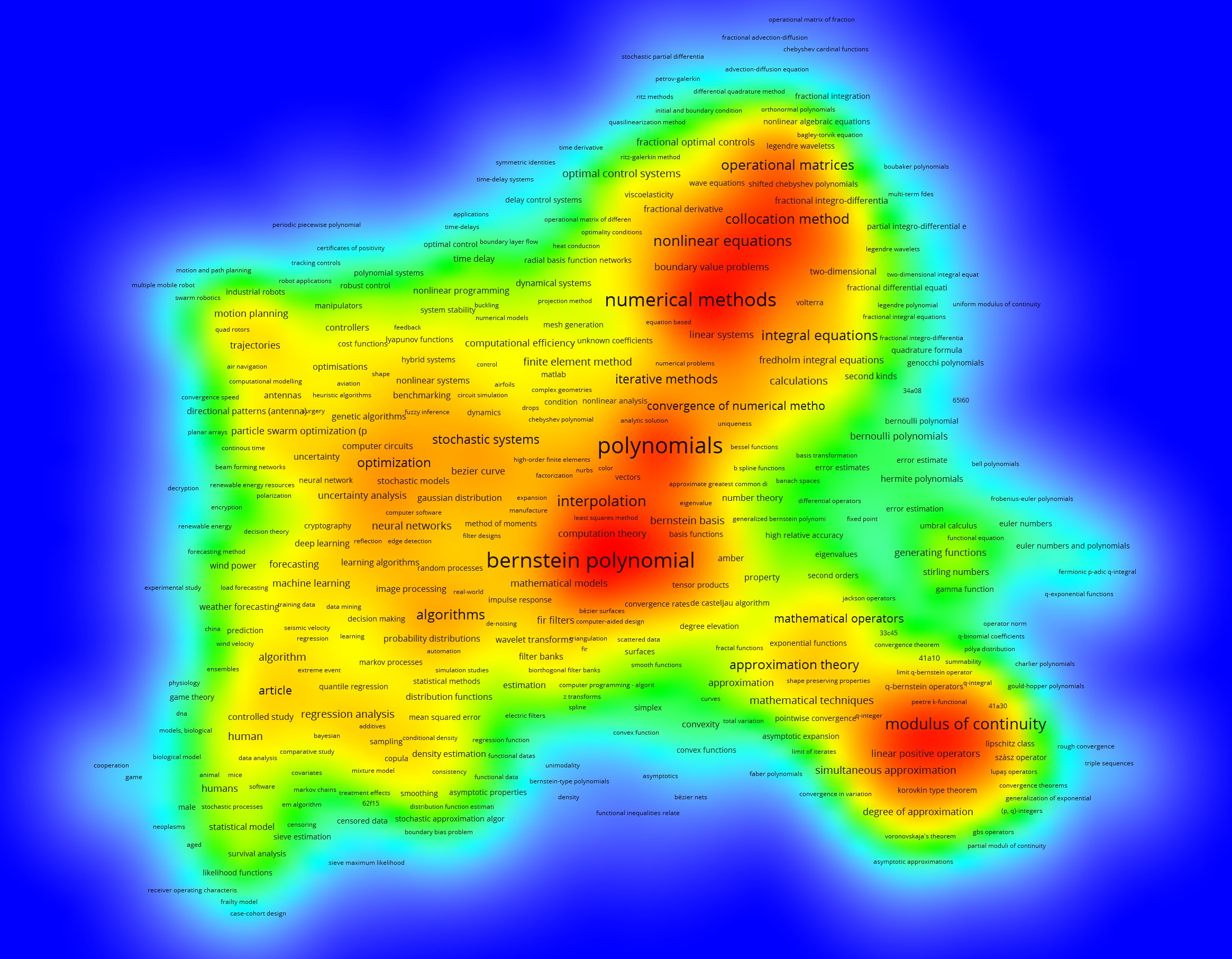
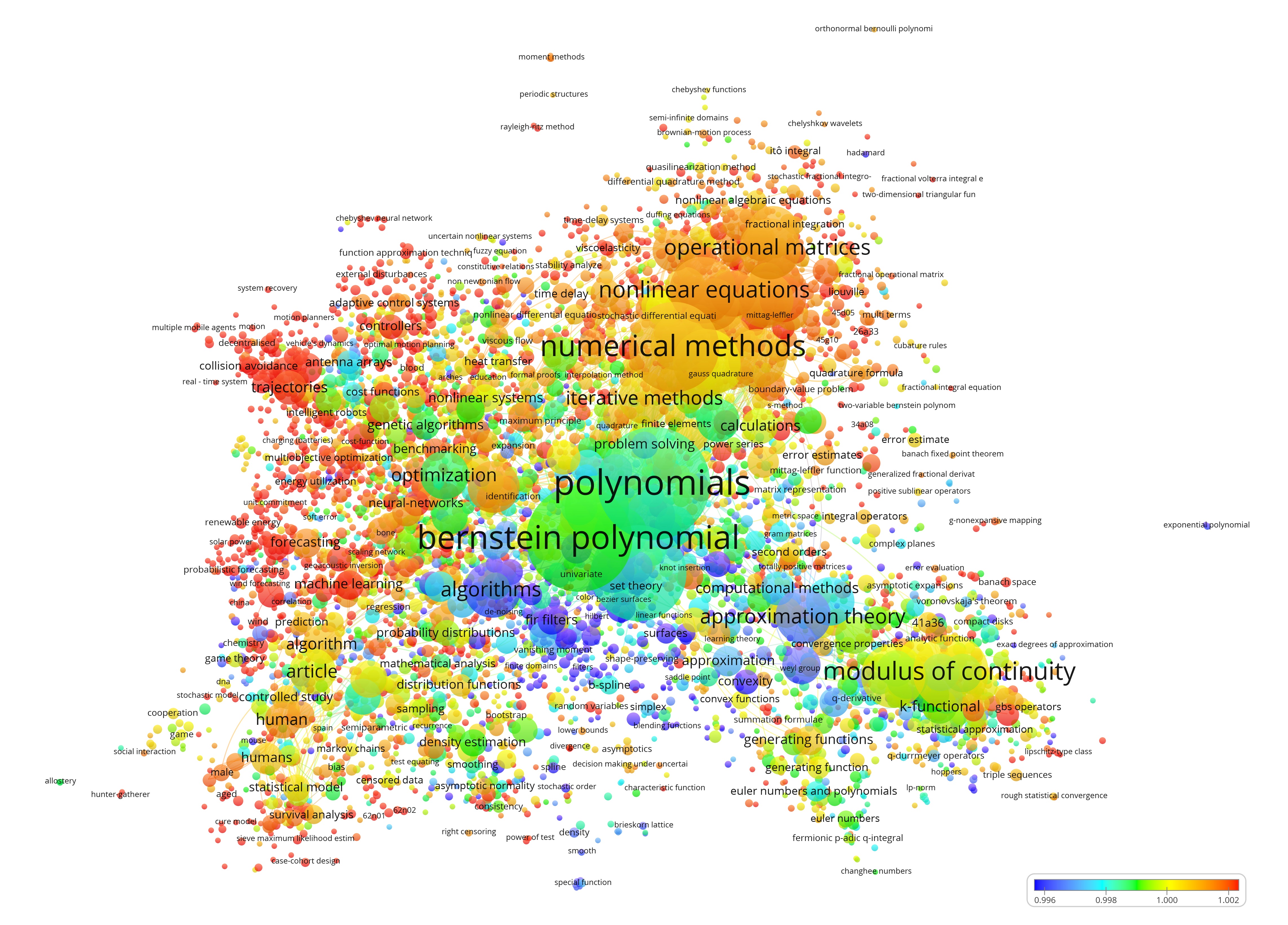
has created 21 clusters that can be seen in different colours in Fig. 6a,
161,307 links, with a total link strength of 261,230. Three types of network visualisations
are shown in Fig. 6.
In VOSviewer [17-19], we used the following
metrics:
• Links
refer to the number of direct connections or relationships between nodes in the
graph. In social networks, for example, this is like counting the number of
friendships between individuals, but without considering the strength of those
friendships.
• Total link strength
is the cumulative weight of all links between nodes in the graph. The weights can
represent the intensity, frequency or importance of the relationships. For
example, a citation network could reflect the number of times two articles have
been co-cited.
• Occurrences
refer to the number of times a particular keyword appears in
the dataset used to construct the graph. For example, the occurrence of
"Bernstein polynomial" indicates how often this term is mentioned in
the data, regardless of its connections to other terms.
Figure 6 contains network
visualisations for the keywords studied. Fig. 6a is a basic network visualisation
where we can observe several clusters coloured by different colours. In
VOSviewer, a cluster represents a group of items (such as keywords, authors, or
publications) that are closely related to each other and more strongly
connected than to items in other clusters. Each cluster is shown in a distinct
colour and typically reflects a thematic or topical area within the overall
network, indicating shared research focus, collaboration patterns or conceptual
similarity. Fig. 6b is a density visualisation (or density map) where the red
colour shows the most popular topics based on the number of occurrences, and
Fig. 6c is the most interesting because the years from 1949 to 2025 were
normalised and connected to the colour map used, so we can observe that
keywords in blue colours, such as algorithms, approximation theory, filters, CAD,
convexity, image reconstruction, and others were relatively more common for
older manuscripts, and motion planning, trajectories, uncertainty, machine
learning, weather forecasting, collision avoidance, neural networks, continuous-time
systems, and others can be found in very recent documents. This means a shift
from traditional mathematical topics to applications and numerical methods.
The appearance of slightly
different upper bound values, such as 1.002 (Figure 6c) and 1.004 (Figure 6),
in a VOSviewer colour map for normalised values is usually due to rounding and
display precision in the software's colour scale rather than an error in the
underlying data.
|
|
|
|
(a)
|
(b)
|
(c)
Figure 6.
Network
visualisation based on the Scopus query and 9310 manuscripts found as of 23
January 2025. (a) Network visualisation, (b)
Density visualisation. A more dynamic visualisation with zooming is available at https://youtu.be/bpqYJVEynQk
(c) Overlay visualisations where years from 1949 to 2025 are normalised
by dividing by the mean. Here, cool colours represent older research topics,
while warm colours represent more recent research topics, so the visualisation
helps to understand the trends for the related research keywords.
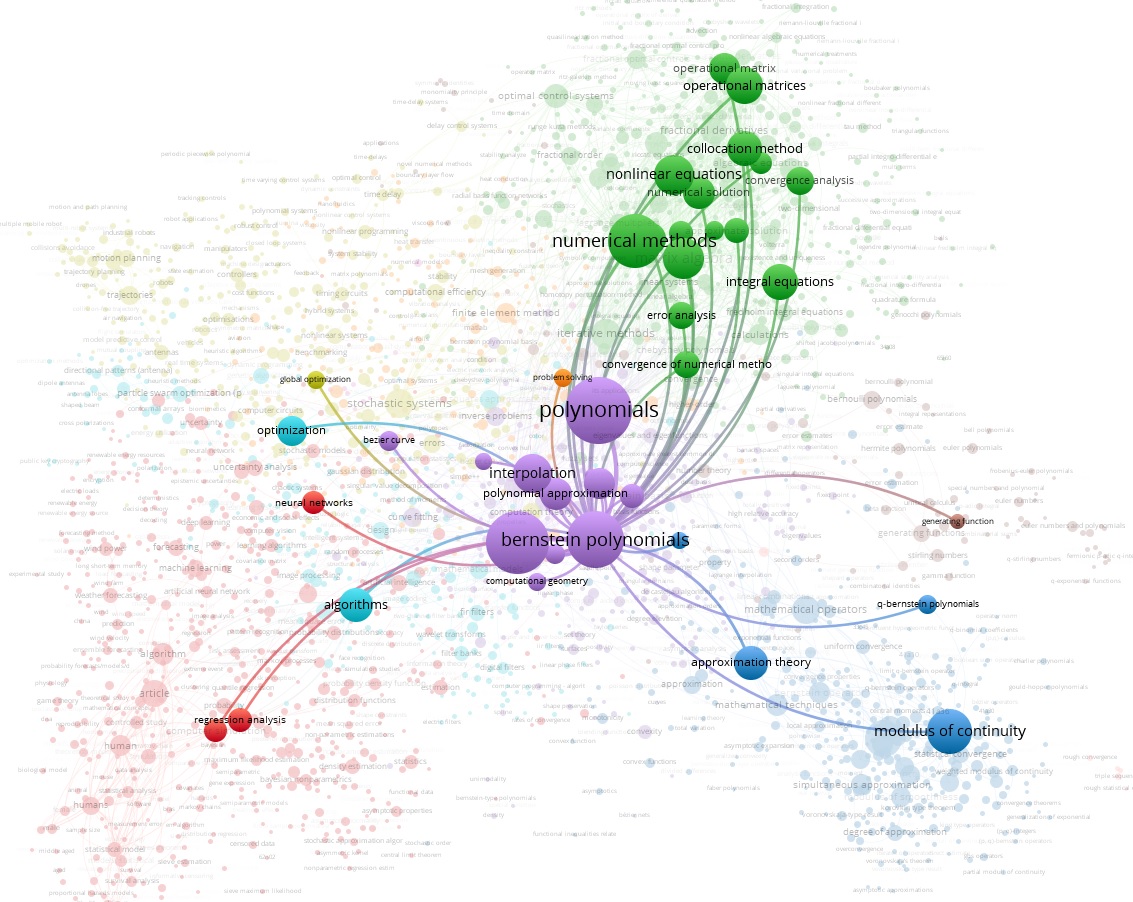
In the network visualisation
(Fig. 7), two phrases are related to Bernstein polynomials: the singular and
plural forms. Both show stronger links with topics such as trajectories,
prediction, optimisation, algorithms, approximation theory, modulus of
continuity, mathematical operators, numerical and iterative methods, matrix
algebra, operational matrices, etc. For “Bernstein” (Fig. 7b): Links=2561, Total
link strength=7911, Occurrences=888, and for "Bernstein polynomials"
(Fig. 7a): Links=1784, Total link strength=4717, Occurrences=728.
|
|

|
|
(a)
|
(b)
|
Figure 7.
Links of
(a) "Bernstein polynomials" and (b) "Bernstein polynomials"
in the resulting network visualisation. The graph in VOSviewer shows them as
different keywords, each with its own links.
|
|

|
|
(a)
|
(b)
|
Figure 8.
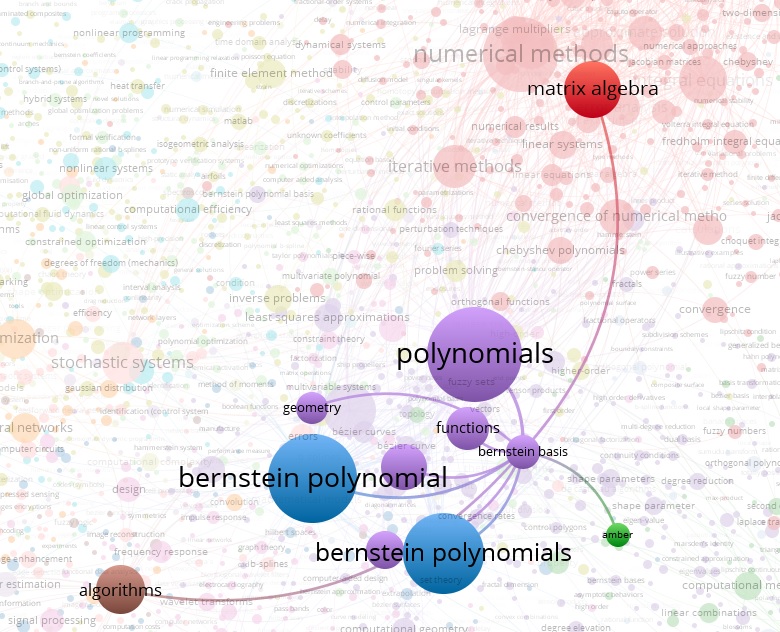
Links of (a) "Bernstein basis" (Links=504,
Total link strength=1081) and (b) "q-Bernstein polynomial"
(Links=162, Total link strength=315) in the resulting network visualisation.
The
A-K-J Sankey diagram, created online using the ScienceScape tool, provides a
visual representation of the relationship between the main authors (A),
keywords (K), and journals (J). The diagram can be accessed via the following
link: https://youtu.be/d2hnhklw8io
By searching for different keywords in
VOSviewer, we can find areas not well connected with Bernstein polynomials in
documents from the Scopus database. For example, searching for
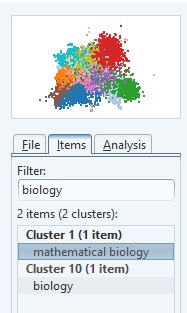
"biology" returned two items from two clusters (Fig. 9).
|
|

|
|
(a)
|
(b)
|
Figure 9.
(a)
One of the interesting branches of applied mathematics, "mathematical
biology" (Links=35, Total link strength=41, Occurrences=3), doesn't have a
strong connection with "Bernstein polynomial". We have something
similar for “biology” Links=38, Total link strength=39, Occurrences=3. (b)
The item "mathematical biology" has a relatively smaller scale than
"integral equations", a mathematical tool used to construct
mathematical models, particularly in biology and ecology.
A Scopus search for (TITLE-ABS-KEY("Bernstein
polynomial") AND TITLE-ABS-KEY("mathematical biology")) returned
only four articles, of which only two papers [20, 21] have titles related to
mathematical biology. Examples of other keywords are given in Table 5.
Strangely, not only "Bernstein polynomial" but both "Bézier
curve" and "Bézier
surface" appear together with "aerospace engineering" in only fifteen
articles. However, the numbers can increase significantly when searching in all
fields.
Table 5.
Keywords rarely appear with
"Bernstein polynomial" in document titles, abstracts or keywords in
the Scopus database.
|
Keyword searched with
"Bernstein polynomial" in Scopus in document title, abstract or
keywords16
|
Number of documents found
|
Notes
|
|
robotics
|
21
|
Only nine articles contain the word
"robot" in their title
|
|
aerospace engineering
|
4
|
Only two articles are related to
aerodynamics and flight vehicle
|
|
composite material
|
4
|
Only two articles mention composites in the
title
|
|
fuzzy logic
|
6
|
Four articles contain the word
"fuzzy" in the title
|
|
electrical engineering
|
3
|
Only one work belongs to a mathematical
journal
|
|
energy engineering
|
0
|
No documents were found
|
|
nuclear
|
3
|
Two documents published in bioscience
sources
|
|
mechanical engineering
|
1
|
Recent work published in 2023
|
|
special function17
|
9
|
Four articles were published in 2024
|
A chat has been started with AI
chatbots about the possible applications of Bernstein polynomials in certain
sub-fields of engineering and mathematics mentioned as keywords in Tables 5 and
7. Interested readers can check out the links in Table 6.
Table 6.
Suggestions from various AI chatbots about applications of Bernstein
polynomials in different fields.
|
AI chatbot
|
Responses
|
|
ChatGPT
|
https://bit.ly/3EjGUlu
|
|
Google Gemini
|
https://bit.ly/3PX0Htg
|
|
Perplexity
|
https://bit.ly/3Ei5N0Q
|
|
Microsoft Copilot
|
https://bit.ly/42B1R5u
|
More
detailed Table 7 shows the co-occurrence of a given keyword related to the
Mathematical Subjects Classification and the keyword "Bernstein
polynomial" in documents in the Scopus database. These numbers have been
manually extracted from the Scopus database. The information can be helpful for
academics looking for new or underexplored areas where Bernstein polynomials
can be applied. Interestingly, the Pearson correlation coefficient between the
number of documents found by searching in "All fields" and
"Article title, abstract, keywords" equals 0.848, indicating a
powerful and positive relationship between the two variables.
Table 7.
Co-occurrence of a given keyword(s) related to the Mathematical Subjects
Classification and "Bernstein polynomial" in documents in the Scopus
database. The two columns "All fields" and "Article title,
abstract, keywords" use the same colour map (Green-Yellow-Red scale in
conditional formatting in Microsoft Excel) but are applied separately to each
other, where red colour indicates low values, and green indicates high values
(number of documents).
|
Top-level code
|
Mathematics Subject Classification (MSC)
and used keywords (in " ")
|
All fields
|
Article title, abstract, keywords
|
|
00
|
General
|
|
|
|
|
"recreational mathematics"
|
0
|
0
|
|
|
"philosophy of mathematics"
|
0
|
0
|
|
|
"mathematical modelling" OR "mathematical
modelling"
|
1291
|
9
|
|
01
|
History and biography
|
|
|
|
|
"history" and "biography"
|
7
|
0
|
|
03
|
Mathematical logic and foundations
|
|
|
|
|
"mathematical logic"
|
4
|
0
|
|
05
|
Combinatorics
|
|
|
|
|
"combinatorics"
|
248
|
2
|
|
06
|
Order, lattices, ordered algebraic structures
|
|
|
|
|
"lattice"
|
277
|
12
|
|
|
"ordered algebraic structure"
|
0
|
0
|
|
08
|
General algebraic systems
|
|
|
|
|
"algebraic system"
|
115
|
16
|
|
11
|
Number theory
|
|
|
|
|
"number theory"
|
383
|
25
|
|
12
|
Field theory and polynomials
|
|
|
|
|
"field theory"
|
60
|
0
|
|
13
|
Commutative algebra (Commutative rings and algebras)
|
|
|
|
|
"commutative algebra"
|
20
|
0
|
|
|
"commutative ring"
|
11
|
0
|
|
14
|
Algebraic geometry
|
|
|
|
|
"algebraic geometry"
|
108
|
1
|
|
15
|
Linear and multilinear algebra; matrix theory
|
|
|
|
|
"linear algebra"
|
348
|
13
|
|
|
"multilinear algebra"
|
35
|
0
|
|
|
"matrix theory"
|
29
|
0
|
|
16
|
Associative rings and (associative) algebras
|
|
|
|
|
"associative ring"
|
0
|
0
|
|
|
"associative algebra"
|
1
|
0
|
|
17
|
Non-associative rings and (non-associative) algebras
|
|
|
|
|
"non-associative ring"
|
0
|
0
|
|
|
"non-associative algebra"
|
0
|
0
|
|
18
|
Category theory; homological algebra
|
|
|
|
|
"category theory"
|
2
|
0
|
|
|
"homological algebra"
|
4
|
0
|
|
19
|
K-theory
|
|
|
|
|
"K-theory"
|
4
|
0
|
|
20
|
Group theory and generalisations
|
|
|
|
|
"group theory"
|
33
|
0
|
|
22
|
Topological groups, Lie groups (and analysis upon them)
|
|
|
|
|
"topological group"
|
2
|
0
|
|
|
"Lie group"
|
65
|
1
|
|
26
|
Real functions (including derivatives and integrals)
|
|
|
|
|
"real function"
|
77
|
8
|
|
28
|
Measure and integration
|
|
|
|
|
"integration"
|
1703
|
107
|
|
30
|
Functions of a complex variable (including approximation
theory in the complex domain)
|
|
|
|
|
"complex variable"
|
114
|
2
|
|
|
"complex domain"
|
79
|
2
|
|
|
"approximation theory"
|
2788
|
98
|
|
31
|
Potential theory
|
|
|
|
|
"potential theory"
|
51
|
1
|
|
32
|
Several complex variables and analytic spaces
|
|
|
|
|
"several complex variables"
|
15
|
0
|
|
|
"analytic space"
|
9
|
0
|
|
33
|
Special functions
|
|
|
|
|
"special function"
|
776
|
9
|
|
34
|
Ordinary differential equations
|
|
|
|
|
"ordinary differential equation"
|
539
|
39
|
|
|
"ODE"
|
219
|
15
|
|
35
|
Partial differential equations
|
|
|
|
|
"partial differential equation"
|
1351
|
62
|
|
|
"PDE"
|
137
|
8
|
|
37
|
Dynamical systems and ergodic theory
|
|
|
|
|
"dynamical system"
|
558
|
17
|
|
|
"ergodic theory"
|
13
|
1
|
|
39
|
Difference (equations) and functional equations
|
|
|
|
|
"difference equation"
|
1227
|
5
|
|
|
"functional equation"
|
182
|
20
|
|
40
|
Sequences, series, summability
|
|
|
|
|
"sequence"
|
1668
|
161
|
|
|
"series"
|
4080
|
130
|
|
|
"summability"
|
280
|
18
|
|
41
|
Approximations and expansions
|
|
|
|
|
"approximation"
|
6026
|
765
|
|
|
"expansion"
|
1268
|
107
|
|
42
|
Harmonic analysis on Euclidean spaces (including Fourier
analysis, Fourier transforms, trigonometric approximation, trigonometric
interpolation, and orthogonal functions)
|
|
|
|
|
"harmonic analysis"
|
186
|
3
|
|
|
"Fourier analysis"
|
241
|
5
|
|
|
"Fourier transform"
|
187
|
9
|
|
|
"trigonometric approximation"
|
54
|
2
|
|
|
"trigonometric interpolation"
|
16
|
2
|
|
|
"orthogonal function"
|
194
|
14
|
|
43
|
Abstract harmonic analysis
|
|
|
|
|
"abstract harmonic analysis"
|
1
|
0
|
|
44
|
Integral transforms, operational calculus
|
|
|
|
|
"integral transform"
|
370
|
1
|
|
|
"operational calculus"
|
30
|
0
|
|
45
|
Integral equations
|
|
|
|
|
"integral equation"
|
1473
|
138
|
|
46
|
Functional analysis (including infinite-dimensional
holomorphy, integral transforms in distribution spaces)
|
|
|
|
|
"functional analysis"
|
1017
|
14
|
|
|
"infinite-dimensional holomorphy"
|
0
|
0
|
|
|
"integral transform in distribution space"
|
0
|
0
|
|
47
|
Operator theory
|
|
|
|
|
"operator theory"
|
552
|
5
|
|
49
|
Calculus of variations and optimal control; optimisation
(including geometric integration theory)
|
|
|
|
|
"calculus of variations"
|
201
|
4
|
|
|
"optimal control"
|
812
|
48
|
|
|
"optimization" or "optimisation"
|
2585
|
237
|
|
|
"geometric integration theory"
|
3
|
0
|
|
51
|
Geometry
|
|
|
|
|
"geometry"
|
958
|
124
|
|
52
|
Convex (geometry) and discrete geometry
|
|
|
|
|
"convex geometry"
|
6
|
0
|
|
|
"discrete geometry"
|
3
|
0
|
|
53
|
Differential geometry
|
|
|
|
|
"differential geometry"
|
79
|
2
|
|
54
|
General topology
|
|
|
|
|
"general topology"
|
22
|
0
|
|
55
|
Algebraic topology
|
|
|
|
|
"algebraic topology"
|
7
|
0
|
|
57
|
Manifolds and cell complexes
|
|
|
|
|
"manifold"
|
201
|
9
|
|
|
"cell complex"
|
1
|
0
|
|
58
|
Global analysis, analysis on manifolds (including
infinite-dimensional holomorphy)
|
|
|
|
|
"global analysis"
|
27
|
0
|
|
|
"analysis on manifolds"
|
8
|
0
|
|
60
|
Probability theory and stochastic processes
|
|
|
|
|
"probability theory"
|
313
|
8
|
|
|
"stochastic process"
|
284
|
11
|
|
62
|
Statistics
|
|
|
|
|
"statistics"
|
2223
|
89
|
|
65
|
Numerical analysis
|
|
|
|
|
"numerical analysis"
|
1465
|
23
|
|
68
|
Computer science
|
|
|
|
|
"computer science"
|
1841
|
6
|
|
70
|
Mechanics of particles and systems (including particle
mechanics)
|
|
|
|
|
"mechanics of particles"
|
0
|
0
|
|
|
"mechanics of systems"
|
0
|
0
|
|
74
|
Mechanics of deformable solids
|
|
|
|
|
"mechanics of deformable solids"
|
0
|
0
|
|
76
|
Fluid mechanics
|
|
|
|
|
"fluid mechanics"
|
270
|
7
|
|
78
|
Optics, electromagnetic theory
|
|
|
|
|
"optics"
|
204
|
3
|
|
|
"electromagnetic theory"
|
29
|
0
|
|
80
|
Classical thermodynamics, heat transfer
|
|
|
|
|
"thermodynamics"
|
50
|
1
|
|
|
"classical thermodynamics"
|
0
|
0
|
|
|
"heat transfer"
|
348
|
14
|
|
81
|
Quantum theory
|
|
|
|
|
"quantum theory"
|
25
|
3
|
|
82
|
Statistical mechanics, structure of matter
|
|
|
|
|
"statistical mechanics"
|
432
|
0
|
|
|
"structure of matter"
|
0
|
0
|
|
83
|
Relativity and gravitational theory (including relativistic
mechanics)
|
|
|
|
|
"relativity theory" or "theory of
relativity"
|
2
|
0
|
|
|
"gravitational theory", "theory of
gravity", or "theory of gravitation"
|
2
|
0
|
|
|
"relativistic mechanics"
|
0
|
0
|
|
85
|
Astronomy and astrophysics
|
|
|
|
|
"astronomy"
|
163
|
1
|
|
|
"astrophysics"
|
139
|
3
|
|
86
|
Geophysics
|
|
|
|
|
"geophysics"
|
107
|
1
|
|
90
|
Operations research, mathematical programming
|
|
|
|
|
"operations research"
|
199
|
0
|
|
|
"mathematical programming"
|
205
|
5
|
|
91
|
Game theory, economics, social and behavioural sciences
|
|
|
|
|
"game theory"
|
55
|
2
|
|
|
"economics"
|
508
|
5
|
|
|
"social science"
|
87
|
2
|
|
|
"behavioural science"
|
19
|
0
|
|
92
|
Biology and other natural sciences
|
|
|
|
|
"biology"
|
501
|
14
|
|
|
"natural science"
|
257
|
3
|
|
93
|
Systems theory; control (including optimal control)
|
|
|
|
|
"systems theory" or "theory of systems"
|
140
|
0
|
|
|
"control theory"
|
302
|
5
|
|
|
"optimal control"
|
812
|
48
|
|
94
|
Information and communication, circuits
|
|
|
|
|
"information and communication"
|
49
|
0
|
|
|
"circuit"
|
746
|
44
|
|
97
|
Mathematics education
|
|
|
|
|
mathematics education or "math education", or
"maths education" or "mathematical education."
|
244
|
0
|
The
bibliometric analysis of published literature is essential for understanding a
research field from a bird’s-eye view: to understand which topics were
popular or unpopular at the time, the significance of the works and authors,
the links between them and other fields, and to identify new directions for
future research. Unfortunately, not all published academic manuscripts are
available in a single academic database such as Scopus. Instead, they are
distributed across the internet in many databases, so extracting
publication-related data can take a long time. Perhaps one day in the future,
we will have a single tool that allows academics to easily access all the
knowledge humanity has generated throughout its existence, summarise it
quickly, translate it between languages, and use integrated AI agents as
intellectual assistants.
In this work, we carried out a bibliometric
analysis of Scopus data for documents containing the keyword "Bernstein
polynomial" across all fields. The analysis showed the main areas of
research where Bernstein polynomials are often and rarely used. It also
revealed how publication trends and keywords have changed over time, and
identified the most cited sources, most mentioned countries, institutions, and
most active authors contributing to this topic. The analysis also resulted in
various visualisations of keyword networks and author networks.
Our findings show that Bernstein polynomials
are frequently applied in approximation theory, optimisation, sequences and
series, integral equations, and geometry, while their presence in fields such
as quantum theory, mathematical logic, associative algebra, homological
algebra, and relativistic mechanics remains very low. Academics from the United
States, China, India, Turkey, and Iran were identified as the most active
contributors. Citation analysis indicated that the highly cited papers mainly
focus on the development and application of Bernstein polynomials and
Bézier forms in geometric modelling, numerical analysis, and approximation
theory, including algorithms, numerical stability, and modern extensions such
as q-Bernstein and fractional calculus methods.
Furthermore, we have found underexplored
connections between Bernstein polynomials and fields such as robotics,
aerospace engineering, composite materials, and others. These observations
suggest promising directions for future research. To explore these
possibilities, a dialogue with AI chatbots was initiated, which generated
several preliminary suggestions for interdisciplinary applications.
The author would like to thank an
anonymous reviewer for their valuable comments, which improved the quality of
this work.
1. Farin, G. Curves and Surfaces for Computer-Aided Geometric Design: A Practical Guide; Elsevier: Amsterdam, The Netherlands, 2014.
2. Lorentz, G.G. Bernstein Polynomials; American Mathematical Society, 2012.
3. Karac?, A.; Buyukyaz?c?, I.; Aktumen, M. Recognition of human speech using q-Bernstein polynomials. Int. J. Comput. Appl. 2010, 975, 8887.
4. Petrone, S. Random Bernstein polynomials. Scand. J. Stat. 1999, 26(3), 373–393.
5. Benavoli, A.; Facchini, A.; Zaffalon, M. Bernstein's socks and polynomial-time provable co-herence. arXiv 2019, arXiv:1903.04406.
6. Farouki, R.T. The Bernstein polynomial basis: A centennial retrospective. Comput. Aided Geom. Des. 2012, 29(6), 379–419.
7. Sederberg, T.W.; Parry, S.R. Free-Form Deformation of Solid Geometric Models. Comput. Graph. 1986, 20, 151–160.
8. Farin, G. Triangular Bernstein-Bezier Patches. Comput. Aided Geom. Des. 1986, 3, 83–127.
9. Farouki, R.T. The Bernstein Polynomial Basis: A Centennial Retrospective. Comput. Aided Geom. Des. 2012, 29, 379–419.
10. Farouki, R.T.; Rajan, V.T. Algorithms for Polynomials in Bernstein Form. Comput. Aided Geom. Des. 1988, 5, 257–281.
11. Farouki, R.T.; Rajan, V.T. On the Numerical Condition of Polynomials in Bernstein Form. Comput. Aided Geom. Des. 1987, 4, 241–256.
12. King, J.P. Positive Linear Operators Which Preserve x2. Acta Math. Hungar. 2003, 99, 203-208.
13. Gao, F.; Wu, W.; Lin, Y.; Shen, S. Online Safe Trajectory Generation for Quadrotors Using Fast Marching Method and Bernstein Basis Polynomial. In Proceedings of the 2018 IEEE International Conference on Robotics and Automation (ICRA), Brisbane, QLD, Australia, 21–25 May 2018; pp. 7034–7040.
14. Sederberg, T.W.; Parry, S.R. Free-Form Deformation of Solid Geometric Models. In Proceedings of the 13th Annual Conference on Computer Graphics and Interactive Techniques (SIGGRAPH 1986), Dallas, TX, USA, 18–22 August 1986; pp. 151–160.
15. Bhrawy, A.H.; Taha, T.M.; Machado, J.A.T. A Review of Operational Matrices and Spec-tral Techniques for Fractional Calculus. Nonlinear Dyn. 2015, 81, 109–135.
16. Ostrovska, S. q-Bernstein Polynomials and Their Iterates. J. Approx. Theory 2003, 123, 232–255.
17. Van Eck, N.; Waltman, L. Software survey: VOSviewer, a computer program for bibli-ometric mapping. Scientometrics 2010, 84(2), 523–538.
18. Orduna-Malea, E.; Costas, R. Link-based approach to study scientific software usage: The case of VOSviewer. Scientometrics 2021, 126(9), 8153–8186.
19. Bukar, U. A., Sayeed, M. S., Razak, S. F. A., Yogarayan, S., Amodu, O. A., & Mahmood, R. A. R. (2023). A method for analyzing text using VOSviewer. MethodsX, 11, 102339.
20. Venturino, E.; Anita, S.; Mezzanotte, D.; Occorsio, D. A High Order Numerical Scheme for a Nonlinear Nonlocal Reaction–Diffusion Model Arising in Population Theory. Journal of Computational and Applied Mathematics 2024, 116082.
21. Yousefi, S.A.; Behroozifar, M.; Dehghan, M. Numerical Solution of the Nonlinear Age-Structured Population Models by Using the Operational Matrices of Bernstein Polynomials. Appl. Math. Model. 2012, 36, 3, 945–963.
22. Soleyman, F.; Area, I.; Masjed-Jamei, M.; Nieto, J.J. Representation of (p,q)-Bernstein polynomials in terms of (p,q)-Jacobi polynomials. J. Inequal. Appl., 2017, 167.
Authors should not confuse bibliometric analysis with bibliographic analysis, which are related but distinct concepts in the study of academic literature and research output.
German Research Foundation
Ministry of Economy and Competitiveness, Spain
Swiss National Science Foundation, Switzerland
Ministry of Science, Innovation and Universities, Spain
Ministry of Education, University and Research, Italy
The Francesco Severi National Institute of Higher Mathematics, Italy
Regional Government of Andalusia, Spain
State Research Agency, Spain
The Foundation for Science and Technology, Portugal
It is not possible to use AI chatbots for all 9310 documents, as most chatbots are
not able to process very long texts.
Academics
themselves can try to find such a field or a topic not well related to
Bernstein polynomials by using a Scopus query (TITLE-ABS-KEY("Bernstein
polynomial") AND TITLE-ABS-KEY("topic of your interest")), or by
using "Bernstein polynomial" AND "topic of your interest"
in Scholar Google.
This
smaller number of documents doesn't mean that Bernstein polynomials or their
generalisations cannot be represented as a special case of more general special
functions or in terms of other polynomials, such as Jacobi polynomials [22].