Swarm intelligence
encapsulates striking capacities for entities as humble as social insects, or
birds and fish that can achieve great results for complex tasks by coordination
but without central guidance [1]. It all comes down to how these little
creatures, following some simple rules, organize and solve problems. This is
not because there is some kind of single entity in control, but a result of
numerous interactions of them with their environment, which naturally leads to
collective and adaptive behaviors [2,3].
So far, this natural
phenomenon has inspired numerous technology advancements, particularly in such
fields as robotics, optimization, and artificial intelligence. For example,
Particle Swarm Optimization (PSO) and Ant Colony Optimization (ACO) are natural
world-inspired algorithms [4,5]. How birds move in flocks, or how ants search
for food, shows the coordination of a swarm that is beyond the reach of
traditional methods in complexity. With each agent testing different possibilities
and progressively zeroing in on the right solution, these algorithms have the
power of many simple agents working in concert to accomplish a greater task
through a process that imitates natural self-organization. Swarm intelligence
is of great utility, specifically in the field of robotics, regarding
situations where an extremely high degree of autonomy and adaptability is
required. In swarm robotics, many robots work together in order to do something
individually, which none of them can do. And that's revolutionary across the
board, from search and rescue to environmental monitoring, even in space
exploration, with highly unpredictable conditions [6,7].
Bibliometric analysis is
one of the quantitative methodologies used in the review of literatures on
given subjects, the assessment of quality of research, identification of
principal themes, and prediction of trends [8,9]. This methodology critically
reviews academic literature and provides insights about the different metrics
of research developments, including citation counts, keyword distributions, and
h-index [10-12]. It also appraises publication volume and research funding over
time [13, 14]. The VOS Viewer was designed by van Eck and Waltman [15] in 2010
and has ever since been rapidly applied to bibliometrics for making
comprehensible maps representing the relationships and main themes of studies.
The bibliometrix R-package helps to do these analyses quantitatively using
tools like a friendly web interface—Biblioshiny—which allows the user to do
studies with data from Scopus or Web of Science databases even if they have no
coding skills [16].
Swarm intelligence has its
roots in thinking derived from nature and now finds its way into myriad
real-life scenarios. Five areas are considered in this paper to cite growing
space that it has a profound impact on.
Optimization Problems: At
the heart of swarm intelligence is its ability to tackle optimization
challenges—essentially finding the best solution among many possibilities.
Particle Swarm Optimization (PSO) and Ant Colony Optimization (ACO) technique
are nature-inspired approaches to optimization in processes such as routing,
scheduling, and the allocation of resources. Thus, in logistics, such methods
serve to reduce the distances traveled. In manufacturing, it helps in reducing
the distances that will be traveled to optimize the production schedule for
efficient use [17-19].
Robotics: The invention of
swarm intelligence has initiated a new revolution in the invention of yet
another new and unique field, i.e., "swarm robotics," in which groups
of robots work together much like social insects to complete tasks that would
be difficult or impossible for a single individual robot. Particularly, it is
the most supportive in disaster situations where robots search for humans under
dangerous conditions, agriculture where drones do field monitoring and farm
management, and manufacturing where robots work collectively to produce some
complicated items [20-22].
Network Design and Management:
Another important application of swarm intelligence is in the field of
telecommunications and computer networks. This type of application deals with
the collective behavior of ants and other social organisms being taken as a
model to improve data routes and bandwidth allocation. This is invaluable in
highly dynamic environments due to the rapid change of network conditions, thus
contributing to the maintenance of smooth and effective data flows [23-25].
Bioinformatics: In fact,
bioinformatics also uses swarm intelligence in the hard area of bioinformatics,
like with the case of solving complex problems in predicting protein
structures, modeling biological systems, or gene expression analysis.
Specifically, the considered methodologies, however, are particularly effective
in the case of the multidimensional data that are typical of this field, as
they give the possibility of finding patterns and relations usually hidden
[26-28].
Data Mining and Analysis:
If there is some domain where the exploratory power of swarm intelligence is
really applied well, then it is surely data mining. In fact, the classification
of information and the ability to predict the tendency of the same while
pointing out outliers are the fields where it is vastly applied. Financial
markets provide another scenario where swarm-based systems would be able to
process large quantities of data with the aim of finding investment
opportunities together with potential threats, and with information from that,
they would be able to inform guiding decisions [29-31]. These applications help
understand how swarm intelligence applies the use of simple and small,
nature-inspired concepts to develop solutions for some very high-level complex
challenges in different domains.
Bibliometric Analysis:
Swarm intelligence (SI) has seen significant growth in research and application
over the past two decades, with bibliometric analyses shedding light on its
evolution and trends. A study by Li et al. explored SI research between 2000
and 2015, identifying key research hotspots and trends through methods like
keyword co-citation analysis and semantic clustering [32]. This analysis
highlighted the widespread application of SI across various fields and provided
insights into the leading countries, institutions, and research performances
driving SI development. Similarly, Reong et al. conducted a bibliometric study
focusing on particle swarm optimization (PSO) strategies for solving the
vehicle routing problem (VRP) over the past 20 years [33]. This study used bibliographic
coupling and co-citation analysis to map emerging trends and identify key
thematic clusters, contributing to the ongoing development of PSO and VRP
research. Both studies demonstrate how bibliometric analyses can uncover
critical trends and guide future research in the rapidly evolving field of
swarm intelligence.
The
scientific studies for this research were sourced from the Scopus database's
main collection. On January 25th, 2024, we conducted a search with "swarm intelligence"
as the keyword. There were no restrictions based on language, and the search
was narrowed to include only peer-reviewed journal articles, conference
proceedings, and book chapters, while excluding meetings, editorials, notes,
and books. This search yielded 1374 articles from 800 different sources,
spanning from 1996 to 2024. We diligently checked the Scopus entries to
eliminate any duplicates, ensuring the highest precision in our data set. The
collected data were then saved in a CSV file format, and we conducted a
bibliometric analysis using VOSviewer version 1.6.19 alongside Bibloshiny
software. Key findings from this study are presented in Table 1.
Table 1. Essential aspects
of the investigation.
|
Main Information about
Data
|
|
Timespan
|
1996:2024
|
|
Sources (Journals,
Books, etc)
|
800
|
|
Documents
|
1374
|
|
Annual Growth Rate %
|
11.67
|
|
Document Average Age
|
6.92
|
|
Average citations per
doc
|
20.67
|
|
References
|
43259
|
|
DOCUMENT CONTENTS
|
|
Keywords Plus (ID)
|
8530
|
|
Author's Keywords (DE)
|
3611
|
|
AUTHORS
|
|
Authors
|
3558
|
|
Authors of
single-authored docs
|
86
|
|
AUTHORS COLLABORATION
|
|
Single-authored docs
|
97
|
|
Co-Authors per Doc
|
3.39
|
|
International
co-authorships %
|
21.11
|
|
DOCUMENT TYPES
|
|
article
|
752
|
|
book chapter
|
49
|
|
conference paper
|
573
|
a.
Annual
Scientific Production
Figure 1 illustrates the
annual scientific production in swarm intelligence research from 1996 to 2024.
The graph reveals a relatively low and stable number of publications from 1996
through the early 2000s, indicating minimal activity in the field during this
period. However, from the mid-2000s onward, there is a noticeable upward trend,
with a gradual increase in the number of publications. This growth becomes more
pronounced after 2010, reflecting the growing interest and expansion of research
in swarm intelligence. The most significant surge occurs between 2020 and 2023,
with the number of publications peaking in 2023, reaching well over 150
articles. In 2024, the number of publications is 24, which may indicate either
a shift in research focus or that data collection for this year is still
incomplete. Overall, the trend shows a steady and substantial rise in swarm
intelligence research output over the past two decades, underscoring the
increasing importance of this field in the scientific community.
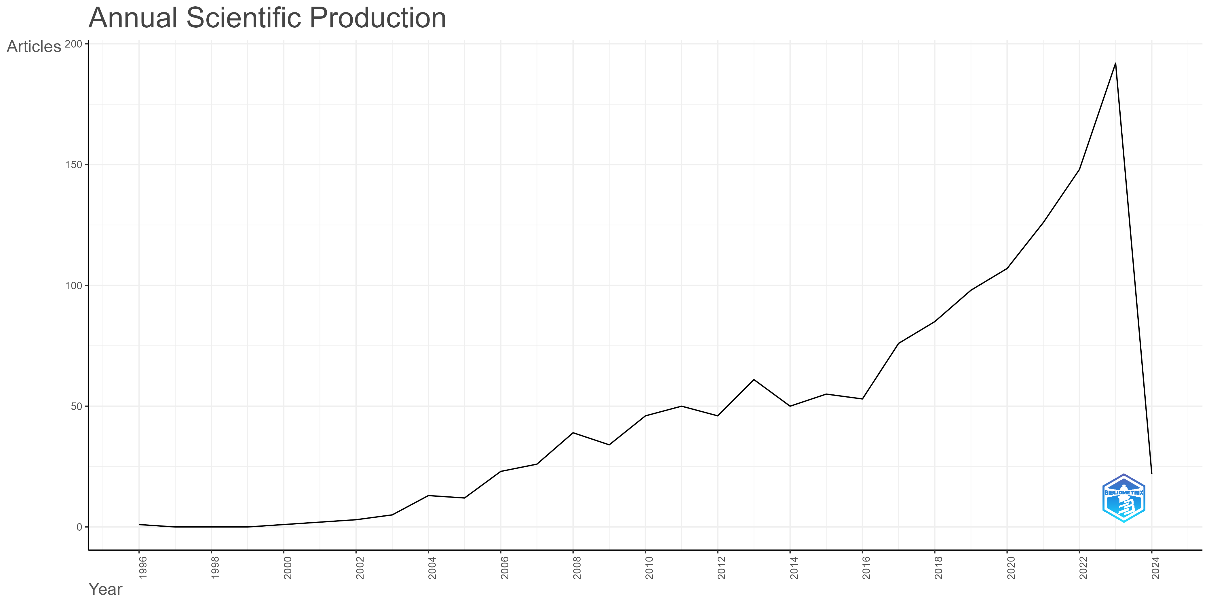
Figure 1.
The annual scientific production
b.
Most
Significant Authors
Table 2 lists the most
prolific authors in a specific field of study, along with the number of
articles they have published. The table is organized with two columns: one for
authors' names and one for the number of articles. At the top, "WANG J"
leads the table with 17 articles, followed by "ZHANG Y" with 16
articles, which suggests these two authors are the most significant
contributors to this field according to the table. They are followed by
"WANG Y" and "ZHANG J," each with 13 articles. "LIU
H" and "WANG X" have each contributed 12 articles. Four authors,
"BACANIN N," "LI J," "TUBA M," and "ZHANG
H," have each published 11 articles, rounding out the list of authors with
double-digit article counts. The presence of multiple authors with the same surnames,
particularly "WANG" and "ZHANG," may indicate commonality
in names within the population from which these authors come, or it could point
to a region where this field of study is particularly active. The number of
articles per author reflects substantial contributions to the scholarly
literature and indicates a consistent level of research output from these
individuals over the time period considered.
Table 2. Most
Significant Authors
|
Authors
|
Articles
|
|
WANG J
|
17
|
|
ZHANG Y
|
16
|
|
WANG Y
|
13
|
|
ZHANG J
|
13
|
|
LIU H
|
12
|
|
WANG X
|
12
|
|
BACANIN N
|
11
|
|
LI J
|
11
|
|
TUBA M
|
11
|
|
ZHANG H
|
11
|
c.
Most
relevant sources and affiliations
Figure 2 shows a bubble
chart in the field of swarm intelligence, plotting various publication sources
against the number of documents they have contributed. Each bubble represents a
source, and its size correlates with the number of documents published by that
source. The x-axis is labeled "N. of Documents" and shows a
numerical scale indicating the volume of published work. On the y-axis, each
row corresponds to a different publication source. The source with the most
substantial contribution is "Lecture Notes in Computer Science (including
subseries)," with 76 documents. This is followed by a cluster of sources
with significantly fewer publications: "Advances in Intelligent Systems
and Computing," "IEEE Access," and the "ACM International
Conference Proceeding Series," each with 27 or 25 documents. A standalone
entry titled "Swarm Intelligence" has 22 documents. Other notable
sources such as "Lecture Notes in Electrical Engineering,"
"Communications in Computer and Information Science," "Expert
Systems with Applications," and "Soft Computing" have
contributions ranging from 10 to 16 documents. The smallest bubble, with 10
documents, corresponds to "Proceedings of SPIE - The International Society
for Optical Engineering." This chart illustrates the distribution and
concentration of research output across various reputable sources within the
field of swarm intelligence, indicating which publications are most frequently
associated with this area of study. The "Lecture Notes in Computer
Science" series stands out as a key repository of knowledge in this
domain.

Figure 2. The most relevant sources
Figure 3 displays a bubble
chart titled "Most Relevant Affiliations," which illustrates the
affiliations associated with the highest number of articles published in the
field of swarm intelligence. The horizontal axis is labeled "Articles"
and shows a count of publications attributed to each affiliation, while the
vertical axis lists the names of the affiliations. The Université Libre
de Bruxelles tops the chart with 31 articles, closely followed by the National
University of Defense Technology with 30 articles, indicating that these
institutions are leading in terms of contribution to the field. Another entry
is labeled as "Not Reported," which also has a significant number of
articles (24) associated with it, suggesting that for many articles, the
authors' affiliations were not specified. Other prominent institutions include
Singidunum University, Wuhan University, Sichuan University, and Tongji
University, each with 24 articles to their credit. Slightly fewer contributions
come from South China University of Technology and Islamic Azad University,
both with 17 articles, and Jilin University with 19 articles. This chart
provides insight into which academic and research institutions are most
actively publishing in the realm of swarm intelligence. The presence of several
Chinese universities indicates a strong research interest and activity in this
field within China.
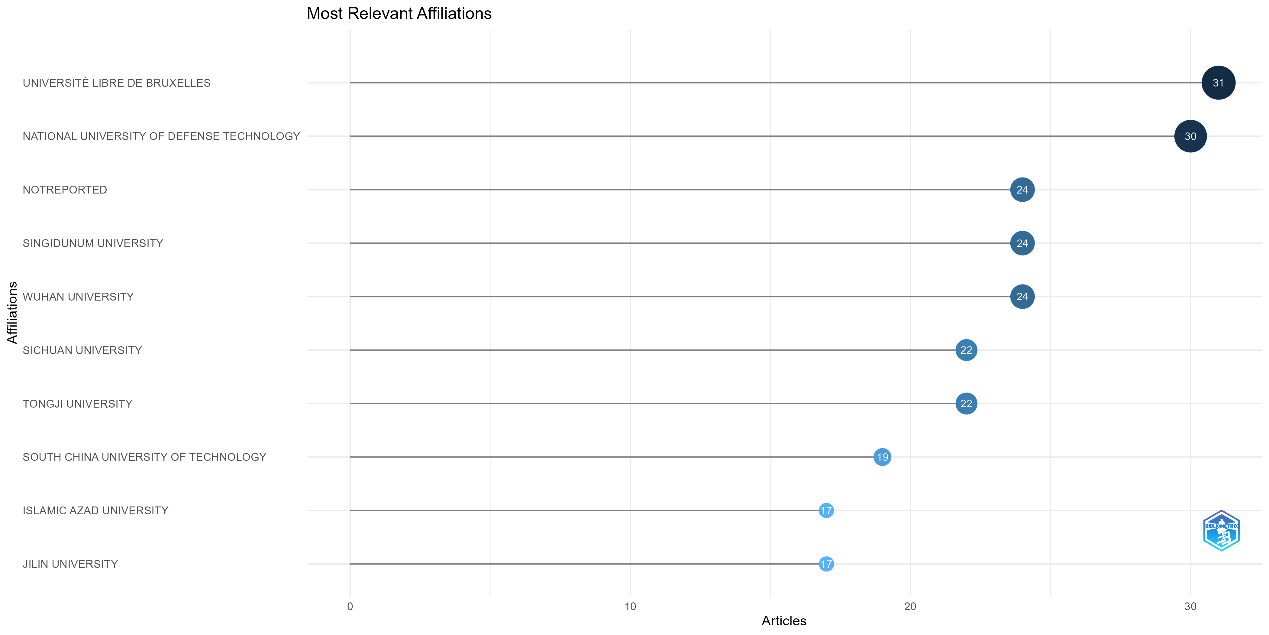
Figure 3. Most relevant affiliations
d.
Three Field Plot of keyword, author and source
The figure 4, three-field
plot is a kind of visual used in bibliometric analyses to describe how the
input data dimensions relate to one another: authors' keywords (DE), authors
(AU), and sources (SO) of the publication. In this visualization, a connection
is made from items in one field to items in another, thus indicating the
association or co-occurrence of items. In the left column (DE), there are
keywords that authors usually used when referring to their paper. To the best
of my knowledge, such keywords are: intelligence, swarm intelligence,
optimization, and metaheuristics, etc. The lines are connecting such keywords
with the middle column (AU), where it is found that it has author names like
Tuba M, Zhang Y, and Liu H. It means that the mentioned authors have written
papers related to the words written at the left. Lastly, sources of the
publications fill the right column (SO), including "Lecture Notes in
Computer Science," "IEEE Access," and "Expert Systems with
Applications." Lines from the authors in the middle column extend to these
sources, showing where their work has been published. The relationship
strengths are often indicated by the density and concentration of the lines.
For example, where a lot of lines are connecting a particular keyword to an
author or a source, this is an indication of strong association or high
activity in that area. This kind of visualization helps to understand between
which authors, the most active domains of research, and which journals or
conferences are publishing it. It also helps to understand the thematic focus
of individual researchers or groups of researchers within a broader research
field.

Figure 4.
Three Field Plot representing the
relationship between author keyword (DE), author (AU) and source (SO) using Biblioshiny.
e.
Frequency
and Co-Occurrence of Keywords
For the purpose of keyword co-occurrence analysis presented
in Figure 5, a dedicated software tool named
SwarmIntelligence_PublicationsAnalysis was developed. This software
incorporates methods for analyzing the frequency of keywords and generating
visual representations of their co-occurrences. The source code has been made
publicly available on GitHub [35] to promote transparency, replicability, and
further exploration of the results. Using this tool, a total of 3,620 keywords
extracted from the selected research articles were evaluated. Keywords with a
minimum occurrence of 15 across different documents were shortlisted and
categorized into three distinct clusters. The most significant keyword, “Swarm
intelligence,” with 495 occurrences, formed Cluster 1. An additional four
keywords - “Optimization,” “Ant colony optimization,” “Particle swarm
optimization,” and “Wireless sensor networks” - each with at least 50 related
publications, were grouped into Cluster 2. The remaining 13 keywords were
assigned to Cluster 3. Based on the assigned clusters, keywords are visually
represented as nodes placed on three concentric rings in the network map, with
each cluster distinguished by a specific color: light blue for Cluster 1, dark
blue for Cluster 2, and violet for Cluster 3. The co-occurrence relationships
between keywords are shown as edges connecting the nodes. These edges are
colored according to the more prominent cluster involved and vary in thickness
to reflect the frequency of co-occurrence. While the visual distinction between
the cluster colors may appear subtle, the clusters remain easily interpretable
due to their spatial distribution, ring-based arrangement, and the relative
strength of the connecting edges. The overall structure effectively conveys the
thematic proximity among keywords and the centrality of specific terms within
the broader research domain. The resulting co-occurrence map is depicted in
Figure 5.

Figure
5. Keyword co-occurrence network with three clusters: light blue (Cluster 1),
dark blue (Cluster 2), and violet (Cluster 3). Node size reflects keyword
frequency, and edge thickness indicates co-occurrence strength.
f.
Publication
Collaboration in World-wide Community
Using the
SwarmIntelligence_PublicationsAnalysis software for visualization [35], a
collaboration network was generated based on publication data from 12 countries
with more than 200 research contributions in swarm intelligence (Figure 6). The
most productive countries—China and India, each with over 1,000
publications—are positioned at the center of the visualization. Each country is
represented as an independent subgraph, where nodes denote individual authors
and yellow-colored internal edges indicate domestic collaborations within that
country. The density of these internal edges reflects the extent of
intra-national research cooperation; for example, China and India display the
densest internal collaboration networks, while countries such as Australia show
sparser domestic co-authorship. Blue edges are used to represent international
collaborations, linking authors from different countries. The thickness of
these edges corresponds to the number of cross-border co-authored publications.
Notably, the United Kingdom has the highest number of international
collaborations (10 connections), while China, India, and the United States
exhibit strong mutual collaborative ties—China and India most frequently
collaborate with the United States, and vice versa. While the visualization
employs similar tones (yellow for domestic and blue for international
collaborations), the structural layout, edge placement, and thickness provide
adequate visual clarity. This figure effectively highlights both the depth of
internal research networks and the breadth of international cooperation in the
swarm intelligence research community. The resulting country-level
collaboration network is illustrated in Figure 6.

Figure 6. Country-wise
collaboration network in swarm intelligence research. Orange nodes represent
authors, yellow edges indicate intra-country collaborations, and blue edges
show international collaborations. Edge thickness reflects collaboration
intensity.
g.
Bibliographic
Coupling with Source
Figure 7 shows a bibliographic
coupling visualization created using VOSviewer, a tool often used for
bibliometric analysis. In this network, nodes represent different sources such
as journals and conference proceedings, and the links between nodes indicate
bibliographic couplings. A bibliographic coupling occurs when two sources cite
the same article(s), suggesting a related thematic focus or research area. In
the visualization, the sources are clustered and color-coded to represent
different thematic groupings or subject areas. The size of each node reflects
the strength of the coupling; larger nodes have more bibliographic couplings,
indicating a higher degree of connection to other sources within the field of
swarm intelligence. The lines connecting the nodes represent the coupling
strength; thicker lines suggest stronger couplings. The node labeled
"Lecture Notes in Computer Science" seems to be one of the larger
ones and central in the network, which means it has strong bibliographic
couplings with many other sources, signifying its prominence in the field.
Other prominent sources, such as "IEEE Access," "Applied Soft
Computing Journal," and "Artificial Intelligence Review," also
have considerable node sizes and numerous connections. This kind of analysis is
valuable for identifying the most influential sources in a field and
understanding how different research areas are interconnected. By examining
such a network, researchers can determine which publications are central to a
particular research community and might therefore be important venues for
publishing their work or for seeking out relevant literature in their field.

Figure 7. The network visualization of bibliographic coupling with sources
h.
Bibliographic
Coupling with Countries
Figure 8 represents a
visualization of the network made using VOSviewer software, showing
bibliographic coupling between countries for studies related to swarm
intelligence. A bibliographic coupling will say the two countries are coupled
if there exists a relationship among the countries with respect to some common
articles that the researcher referred to as part of the same article. In each
node of the network, each point corresponds to a country, and the sizes of the
nodes are in relation to the number of publications emanating from that
particular country, which connects to those of other countries. Thus, the
thickness of the links between the nodes represents the strength of the
bibliographic coupling. Thicker lines, therefore, mean a stronger bibliographic
coupling between the countries. This graph charts countries likely to be of
different clusters/groups having similar research interests or being from the
same region. Such as the United States, China, and India, the giant central
nodes very clearly indicate that these countries must have a large fraction of
coupling, showing the central role in the international research network. The
rich communication channels with each of these and other countries—the Germany,
Brazil, and Japan—allude to a very robust and tightly knit worldwide research
landscape, wherein large cross-referencing of scholarly work occurs. The
network is used to identify in which countries there might be strong
collaboration or influence with respect to certain research topics, meaning the
human eye may make sense of the international academic research and
collaboration landscape.
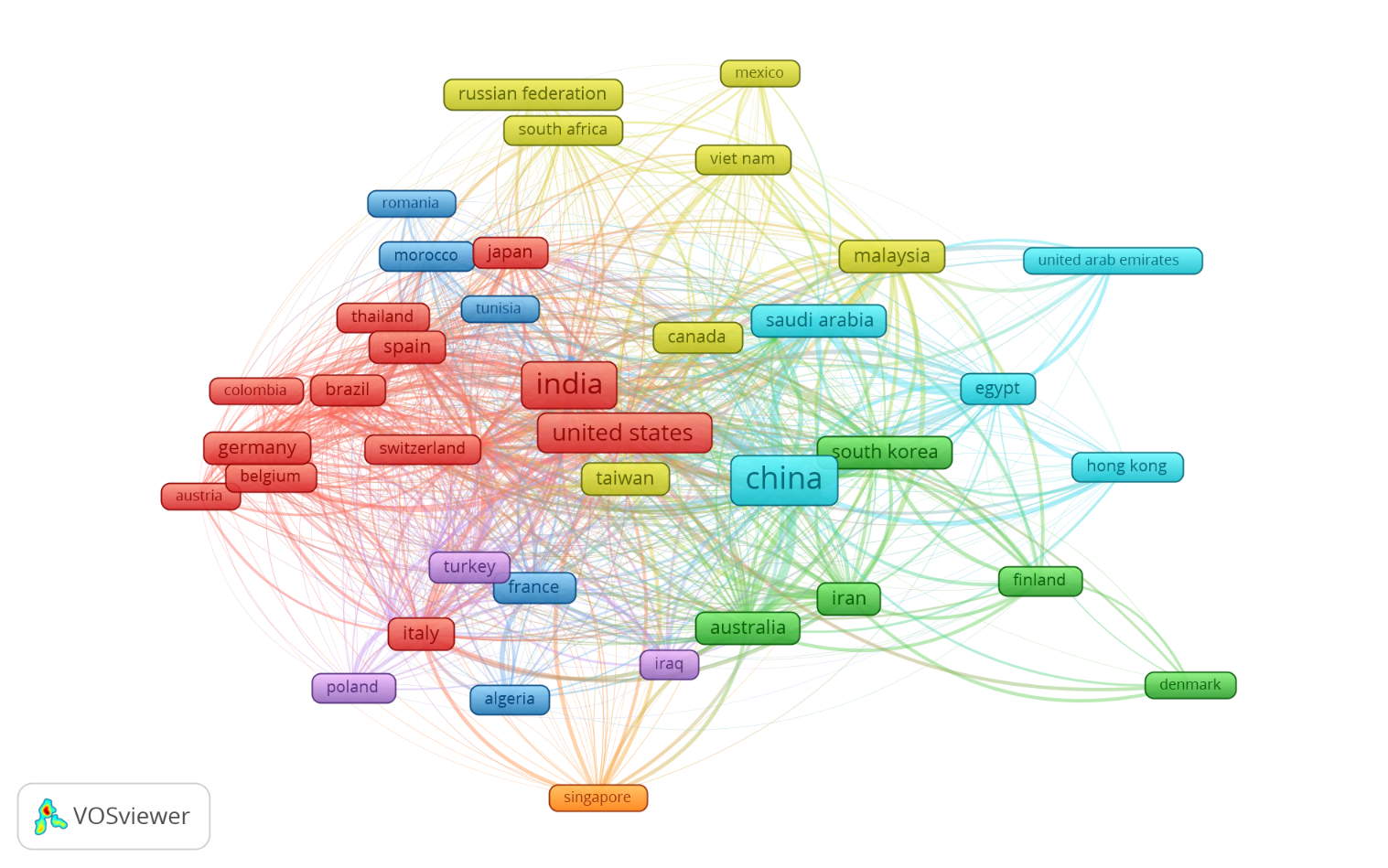
Figure 8. The network visualization of bibliographic coupling with countries
i.
Most Influential Articles
Table 3 presents a list of the
most influential articles in the field of swarm intelligence, ranked based on
their global citation counts. The article "A powerful and efficient
algorithm for numerical function optimization: artificial bee colony (ABC)
algorithm" published in 2007 holds the top position with a staggering 6011
citations, underscoring its foundational impact on the research community. This
paper introduced the ABC algorithm, which has become widely adopted in
optimization tasks. The second and third entries, both surveys on the ABC
algorithm and swarm robotics, reflect the growing academic interest in
exploring and applying swarm-based algorithms across diverse applications, each
accumulating over 1000 citations. Other notable contributions include studies
on the "wisdom of the crowd" effect, bee swarm intelligence
algorithms, and glowworm swarm optimization. These articles, with citation
counts ranging from several hundred to thousands, indicate the broad adoption
of swarm intelligence across fields such as numerical optimization, robotics,
social behavior modeling, and even financial portfolio optimization. The high
citation numbers reflect not only the academic interest but also the practical
relevance of swarm intelligence in solving complex, real-world problems.
Table 3. Most Influential Articles in
Swarm Intelligence Based on Global Citation Count
|
Document
Title
|
DOI
|
Year
|
No. of Citations
|
|
A
powerful and efficient algorithm for numerical function optimization:
artificial bee colony (ABC) algorithm
|
10.1007/s10898-007-9149-x
|
2007
|
6011
|
|
A
comprehensive survey: artificial bee colony (ABC) algorithm and applications
|
10.1007/s10462-012-9328-0
|
2014
|
1382
|
|
Swarm
robotics: a review from the swarm engineering perspective
|
10.1007/s11721-012-0075-2
|
2013
|
1173
|
|
How
social influence can undermine the wisdom of crowd effect
|
10.1073/pnas.1008636108
|
2011
|
646
|
|
A
survey: algorithms simulating bee swarm intelligence
|
10.1007/s10462-009-9127-4
|
2009
|
543
|
|
Glowworm
swarm optimization for simultaneous capture of multiple local optima of
multimodal functions
|
10.1007/s11721-008-0021-5
|
2009
|
384
|
|
Multipurpose
Reservoir Operation Using Particle Swarm Optimization
|
10.1061/(ASCE)0733-9496(2007)133:3(192)
|
2007
|
256
|
|
Particle
Swarm Optimization (PSO) for the constrained portfolio optimization problem
|
10.1016/j.eswa.2011.02.075
|
2011
|
222
|
From this comprehensive
bibliometric analysis on research carried out in the field of swarm
intelligence, some interesting insights about the evolution, contributors, and
collaborative dynamics in this emerging field come forth. Swarm intelligence
research would then appear to be an area of increasing interest and investment,
highlighted by the huge uptick in 2024, of course, and the slow but steady rise
in annual scientific production since the turn of the century. This increase in
publication output may be indicative of either greater research activity or
increased awareness of the possible applications and importance of swarm
intelligence in a number of areas. However, great care is needed in the
interpretation of this peak since it may as well be influenced by other factors
such as incomplete data collection or different patterns of reporting.
Regardless of that, the general tendency of the increase should point out and
state the growing importance and relevancy of swarm intelligence as a subject
for scholarly inquiry.
Identification of the
prolific authors and their contribution lightens up on the individuals behind
the research in this field. We observe an influential contribution, mainly from
authors such range from WANG J to ZHANG Y, with consistent output in their
record of publication. This presence may indicate common naming practices
within the same geographic area or even cultural context—i.e., the commonality
of WANG and ZHANG authors with the same or similar surname. It may indicate
that the body of research in this specific area is originating from some sorts
of clusters of activity in particular geographic areas.
In addition, average
co-authors per document and international co-authorship are presented as a
percentage of the total, which points towards the collaborative nature of swarm
intelligence research involving a global pool of researchers for the
advancement of knowledge in this domain. Source analysis and affiliation most
relevant are to highlight those key publications and academic institutions at
the frontier of swarm intelligence research. Such great importance attached to
publications such as "Lecture Notes in Computer Science" and
associations such as Université Libre de Bruxelles attests to the
importance of the same publications in the diffusion and production of research
within the area of specialty.
To some extent, the fact
that multiple Chinese universities feature between the top affiliations points
to a focus of research interest and activity from the country's side on swarm
intelligence. That is, the concentration of this kind of research within China
could very well be indicative of the global dispersion of scholarly research on
this topic and mirror country-level distributions of expertise in this area.
The visualizations of keyword co-occurrence, publication collaboration, and
bibliographic coupling provide more insight into the thematic focus,
collaborative networks, and influence within the context of swarm intelligence
research. The strong association of central keywords, such as "swarm
intelligence," with related concepts like "particle swarm
optimization," reflects the interrelatedness of the research theme and
shows light on the very high depth of inquiry in very focused specific topics
within a broader subject area.
Further, the given network
diagram for publication collaboration between countries clearly depicts that
this has to be a global trend for research in the field of swarm intelligence,
where China, the United States, and India become the central point for collaboration
and research output. This bibliometric analysis offers valuable insights into
the current state of research, identifying leading contributors and mapping
collaboration patterns in the field of swarm intelligence. This contribution
identified an increase in publication output, prolific authors, and influential
sources, lending credence to the interdisciplinary and cross-continent nature
of swarm intelligence research. Moreover, further exploration and analysis of
related scholarly publications in the field will become imminent for developing
our understanding of swarm intelligence and further derivation of its potential
for problem-solving for a series of complex real-life applications.
The study confirms the
extensive applicability of swarm intelligence across various domains, as
highlighted in the literature review. The co-occurrence and clustering of
keywords such as 'optimization,' 'particle swarm optimization,' and 'ant colony
optimization' indicate that swarm intelligence techniques are frequently
applied to complex optimization problems. The clustering analysis in the
results section identifies three key thematic areas where swarm intelligence is
extensively used: optimization problems, especially in routing and resource
allocation; swarm robotics, which is critical in decentralized coordination
tasks like search and rescue, agriculture, and manufacturing; and network
design and bioinformatics, where it helps solve dynamic network challenges and
analyze intricate biological data. The keyword co-occurrence and bibliographic
coupling analyses confirm that swarm intelligence is not just a theoretical
concept but is actively applied to practical challenges, reinforcing its
significance in both industrial and academic settings.
The significance of the
study lies in its ability to present a comprehensive overview of the current
research landscape in swarm intelligence, highlighting key contributors,
influential sources, and international collaboration networks. The sharp
increase in research output reflects the growing importance of swarm
intelligence, particularly in its applications to optimization, robotics, and
artificial intelligence. By analyzing thematic focus and collaboration
patterns, this study provides a basis for identifying focal research areas and
guiding future scholarly efforts in swarm intelligence. The identification of
prolific authors and leading sources helps researchers and practitioners focus
on high-impact work, driving real-world advancements in areas such as disaster
management, bioinformatics, and autonomous systems. This research holds
substantial value for both academic researchers and industry practitioners. In
academia, the insights can guide future studies and collaborations, while
practitioners in fields like robotics, telecommunications, and optimization can
apply swarm intelligence algorithms—such as Particle Swarm Optimization and Ant
Colony Optimization—to solve complex real-world problems, including network
design and autonomous decision-making. Understanding the global research
landscape is crucial for stakeholders aiming to expand the applications of
swarm intelligence in interdisciplinary areas such as artificial intelligence,
machine learning, and complex systems. Therefore, this study offers a
comprehensive overview of the field and its potential to drive innovation
across various high-impact sectors.
This bibliometric
analysis is very useful in giving light to the whole body of the scholarly
landscape about the swarm intelligence research. The findings pointed at a
marked increase in the publications over time, with 2024 as one of the prolific
years. We also identified key contributors to the field's advancement, such as
prolific authors and influential sources. Co-occurrence analysis indicates the
central themes and foci in studies of Swarm Intelligence. Similarly, the
publication collaboration analysis points to an expansive network of
international collaborative research. Bibliographic coupling further
demonstrates that there is some kind of cohesiveness between scientific works
and the presence of certain sources in the field. Overall, the research makes a
good contribution to in-depth study of trends, patterns, and dynamics of what
shapes swarm intelligence research and, hence, gives a basis for future studies
and developments.
1. Chakraborty, A., & Kar, A. K. (2017). Swarm intelligence: A review of algorithms. Nature-inspired computing and optimization: Theory and applications, 475-494.
2. Liu, Y., & Passino, K. M. (2000). Swarm intelligence: Literature overview. Department of electrical engineering, the Ohio State University.
3. Garnier, S., Gautrais, J., & Theraulaz, G. (2007). The biological principles of swarm intelligence. Swarm intelligence, 1, 3-31.
4. Parpinelli, R. S., & Lopes, H. S. (2011). New inspirations in swarm intelligence: a survey. International Journal of Bio-Inspired Computation, 3(1), 1-16.
5. Chu, S. C., Huang, H. C., Roddick, J. F., & Pan, J. S. (2011). Overview of algorithms for swarm intelligence. In Computational Collective Intelligence. Technologies and Applications: Third International Conference, ICCCI 2011, Gdynia, Poland, September 21-23, 2011, Proceedings, Part I 3 (pp. 28-41). Springer Berlin Heidelberg.
6. Bansal, J. C., Singh, P. K., & Pal, N. R. (Eds.). (2019). Evolutionary and swarm intelligence algorithms (Vol. 779). Cham: Springer.
7. Yang, X. S., Cui, Z., Xiao, R., Gandomi, A. H., & Karamanoglu, M. (Eds.). (2013). Swarm intelligence and bio-inspired computation: theory and applications. Newnes.
8. Chen, C., Dubin, R., & Kim, M. C. (2014). Emerging trends and new developments in re-generative medicine: A scientometric update (2000–2014). Expert Opinion on Biological Therapy, 14(9), 1295–1317. https://doi.org/10.1517/14712598.2014.920813, PubMed: 25077605
9. Yu, Y., Li, Y., Zhang, Z., Gu, Z., Zhong, H., Zha, Q., Yang, L., Zhu, C., & Chen, E. (2020). A bibliometric analysis using VOSviewer of publications on COVID-19. Annals of Translational Medicine, 8(13), 816. https://doi.org/10.21037/atm-20-4235
10. Godin, B. (2006, July 1). On the origins of bibliometrics. Scientometrics, 68(1), 109–133. https://doi.org/10.1007/s11192-006-0086-0
11. Hood, W. W., & Wilson, C. S. (2001, October 1). The literature of bibliometrics, scientometrics, and informetrics. Scientometrics, 52(2), 291–314. https://doi.org/10.1023/A:1017919924342
12. Ellegaard, O., & Wallin, J. A. (2015, December 1). The bibliometric analysis of scholarly production: How great is the impact? Scientometrics, 105(3), 1809–1831. https://doi.org/10.1007/s11192-015-1645-z
13. Khakimova, A. Kh., Zolotarev, O. V., & Berberova, M. A. Coronavirus infection study: Bibliometric analysis of publications on COVID-19 using PubMed and Dimensions databases. Scientific Visualization, 12(5), 112–129. https://doi.org/10.26583/sv.12.5.10, PubMed: PubMed and Dimensions databases (2020)
14. Zhang, B., Rahmatullah, B., Wang, S. L., Zhang, G., Wang, H., & Ebrahim, N. A. (2021). A bibliometric of publication trends in medical image segmentation: Quantitative and qualitative analysis. Journal of Applied Clinical Medical Physics, 22(10), 45-65. https://doi.org/10.1002/acm2.13394
15. Nobanee, H., Al Hamadi, F. Y., Abdulaziz, F. A., Abukarsh, L. S., Alqahtani, A. F., AlSubaey, S. K., Alqahtani, S. M., & Almansoori, H. A. (2021). A bibliometric analysis of sustainability and risk management. Sustainability, 13(6), 3277. https://doi.org/10.3390/su13063277
16. Agbo, F. J., Oyelere, S. S., Suhonen, J., & Tukiainen, M. (2021). Scientific production and thematic breakthroughs in smart learning environments: A bibliometric analysis. Smart Learning Environments, 8(1), 1–25. https://doi.org/10.1186/s40561-020-00145-4
17. Blum, C., & Li, X. (2008). Swarm intelligence in optimization. In Swarm intelligence: introduction and applications (pp. 43-85). Berlin, Heidelberg: Springer Berlin Heidelberg.
18. Yang, F., Wang, P., Zhang, Y., Zheng, L., & Lu, J. (2017, October). Survey of swarm intelligence optimization algorithms. In 2017 IEEE international conference on unmanned systems (ICUS) (pp. 544-549). IEEE.
19. Tang, J., Liu, G., & Pan, Q. (2021). A review on representative swarm intelligence algorithms for solving optimization problems: Applications and trends. IEEE/CAA Journal of Automatica Sinica, 8(10), 1627-1643.
20. Khaldi, B., & Cherif, F. (2015). An overview of swarm robotics: Swarm intelligence applied to multi-robotics. International Journal of Computer Applications, 126(2).
21. Blum, C., & Gro?, R. (2015). Swarm intelligence in optimization and robotics. Springer handbook of computational intelligence, 1291-1309.
22. Bay?nd?r, L. (2016). A review of swarm robotics tasks. Neurocomputing, 172, 292-321.
23. Kassabalidis, I., El-Sharkawi, M. A., Marks, R. J., Arabshahi, P., & Gray, A. A. (2001, November). Swarm intelligence for routing in communication networks. In GLOBECOM'01. IEEE Global Telecommunications Conference (Cat. No. 01CH37270) (Vol. 6, pp. 3613-3617). IEEE.
24. Di Caro, G., Ducatelle, F., & Gambardella, L. M. (2005, June). Swarm intelligence for routing in mobile ad hoc networks. In Proceedings 2005 IEEE Swarm Intelligence Symposium, 2005. SIS 2005. (pp. 76-83). IEEE.
25. Oliveira, M., Pinheiro, D., Macedo, M., Bastos-Filho, C., & Menezes, R. (2020). Uncovering the social interaction network in swarm intelligence algorithms. Applied Network Science, 5, 1-20.
26. Das, S., Abraham, A., & Konar, A. (2008). Swarm intelligence algorithms in bioinformatics. In Computational Intelligence in Bioinformatics (pp. 113-147). Berlin, Heidelberg: Springer Berlin Heidelberg.
27. Agrawal, S., & Silakari, S. (2015). A review on application of particle swarm optimization in bioinformatics. Current bioinformatics, 10(4), 401-413.
28. Abdul-Rahman, S., Bakar, A. A., & Mohamed-Hussein, Z. A. (2013, December). Optimizing big data in bioinformatics with swarm algorithms. In 2013 IEEE 16th international conference on computational science and engineering (pp. 1091-1095). IEEE.
29. Cheng, S., Zhang, Q., & Qin, Q. (2016). Big data analytics with swarm intelligence. Industrial Management & Data Systems, 116(4), 646-666.
30. Cheng, S., Shi, Y., Qin, Q., & Bai, R. (2013, October). Swarm intelligence in big data analytics. In International conference on intelligent data engineering and automated learning (pp. 417-426). Berlin, Heidelberg: Springer Berlin Heidelberg.
31. Nguyen, B. H., Xue, B., & Zhang, M. (2020). A survey on swarm intelligence approaches to feature selection in data mining. Swarm and Evolutionary Computation, 54, 100663.
32. Li, Z., Zeng, L., Zhong, H., & Wu, J. (2016). Research Hotspots and Trends in Swarm Intelligence: From 2000 to 2015. , 24-35. https://doi.org/10.1007/978-3-319-41000-5_3.
33. Reong, S., Wee, H., & Hsiao, Y. (2022). 20 Years of Particle Swarm Optimization Strategies for the Vehicle Routing Problem: A Bibliometric Analysis. Mathematics. https://doi.org/10.3390/math10193669.
34. Masalsky, L. S., Logunova, O. S., Ilina, E. A., & Arefeva, D. Y. (2023). Visualization of Interstructural Collaborations in Publication Activity of Teaching Staff. In Graphicon-Conference on Computer Graphics and Vision (Vol. 33, pp. 213-219).
35. SwarmIntelligence_PublicationsAnalysis: Repository of the original software code files https://github.com/iamanonym/SwarmIntelligence_PublicationsAnalysis (2024). Accessed on 10 Sept 2024